Oilfield & Wastewater Point-to-Point LoRa Radio Systems — Replace the Cable, Not the SCADA
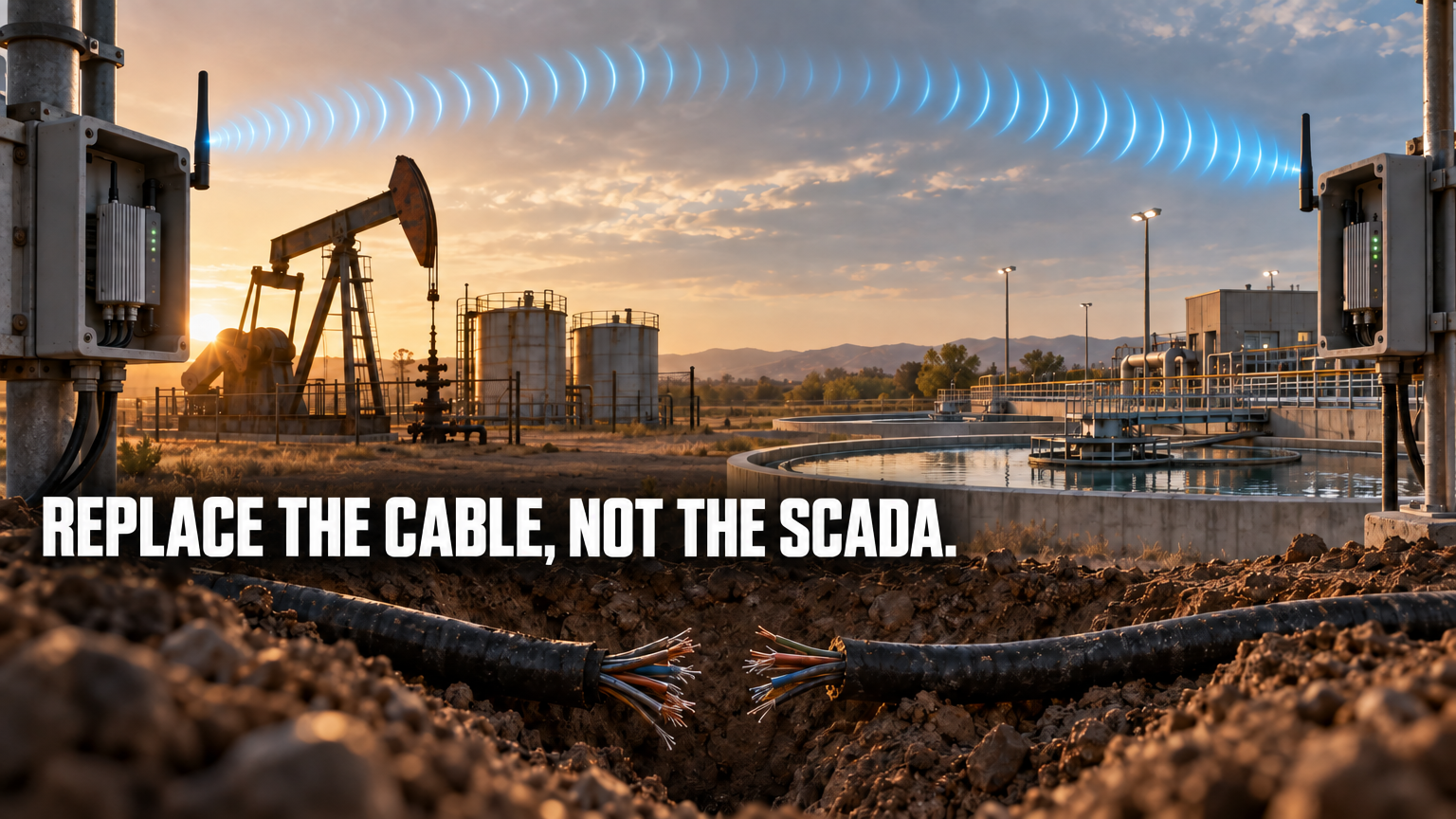
Most oilfield and wastewater telemetry problems are cable problems. A 4-20mA transmitter, a dry contact, or an RS485/Modbus device sits at one point, the control system sits at another, and the space between them is where the budget goes: trenching, conduit, cable, terminations, and labor. BearMar sells point-to-point LoRa radios that move that signal up to 8 mi without a gateway, without a SIM card, and without monthly fees.
Point-to-point LoRa is a direct radio link between two fixed points. One radio connects to the instrument, the other connects to the PLC, RTU, or panel. The signal that arrives is the signal that left, whether that is a 4-20mA loop, a dry contact, or an RS485/Modbus register set. Because the link is direct, there is no gateway, no broker, no cloud subscription, and no monthly bill. That is the core economic difference from a cellular SCADA RTU, where the hardware is only the start of a recurring cost.
Choosing hardware comes down to three questions. What is the interface at each end? A 4-20mA loop, a dry contact, and an RS485/Modbus bus each need a matching radio. How far apart are the points, and is there line of sight? The rated range is up to 8 mi; real-world reach depends on terrain, antenna height, and obstructions, so plan for margin. What powers each end? Solar with battery is common where grid power is absent.
If you are comparing this against a cellular RTU, model the monthly fee over the life of the field, not the first year. If you are comparing it against hardwired 4-20mA or RS485, model trenching and conduit. Point-to-point LoRa wins where the distance is real, the points are fixed, and the recurring cost needs to be zero.
Challenges BearMar Simplifies By Replacing Sensor Wires
- Remote Pressure and Flow
- Pipeline Leak Detection
- Tank Level and Overflow
- Chemical Injection
- Wellhead and Separator Monitoring
- Compressor and Pump Health
How the LoRa Point to Point System Works
A point-to-point system is a direct radio link. The field node reads its sensor, packetizes the reading, and transmits it over a LoRa radio link straight to a receiver, gateway, or base station. No network server sits in the path, and there is no join process for the node to complete.
That matters most on the return path. An acknowledgement, a setpoint change, or a command travels back over the same radio link as soon as the node is listening. Nothing waits on a server round trip or a scheduled downlink window, so response times stay short and predictable. One node, one receiver, one link to keep working.
Signal types supported
Most ranch and oilfield sites carry a mix of older transmitters and newer smart instruments. The goal is to read the signals already on site rather than require you to replace instruments.
Typical inputs include:
- Analog 4-20 mA and 0-10 V loops, for pressure, tank level, temperature, and similar continuous readings
- Dry contact and digital pulse inputs, for flow totalizers, run hours, and counters
- RS-485 / Modbus, for smart transmitters, flow computers, and controllers
- Digital status inputs, for pump run state, valve position, and alarm contacts
Those map to what gets watched at a well pad or pump site: pressure, tank level, flow, run status, pump and valve state, temperature. Send us your signal list and we will tell you how it fits.
Point-to-point vs LoRaWAN
Both approaches use LoRa radios. The difference is what sits between the sensor and the person reading the data.
Point to point is a direct link. Fewer hops, no network server dependency, immediate and predictable downlink, and simpler deployment when you are monitoring a single remote site.
LoRaWAN is a network architecture. It suits many distributed nodes feeding one system through managed infrastructure, where a server round trip is an acceptable tradeoff. It is a good fit for some sites. It is the wrong fit when a command has to arrive now.
Range and line-of-sight
Range is mostly a function of the site, not the datasheet. Terrain, antenna height, Fresnel zone clearance, and local noise all shape how far a link will carry. An elevated antenna with clear line of sight will run far. Hills, trees, tanks, and metal structures cut into that, sometimes sharply.
Because of this, we recommend a site survey or range check before you commit to a layout. If an obstacle sits in the path, a store-and-forward node or a repeater hop can often route around it.
Send your signal list and site details and we will put together a link assessment for your location.
Why No Gateway and No Monthly Fees Changes the Economics
A monitoring point is usually priced twice: once for the hardware, and again every month for as long as it stays in service. With a direct point-to-point LoRa link, that second charge does not exist.
The field node talks straight to a receiver or base station the site owns. There is no LoRaWAN network server, no third-party network operator, and no per-device data subscription anywhere in the path. What disappears:
- Monthly per-node charges
- SIM or airtime plans to keep active
- Network subscriptions to renew
- A server to host or maintain
The radio link is yours once it is installed. A monitoring point then costs what the hardware costs, not hardware plus an ongoing fee per device, per month, forever.
To be clear, the site still needs a receiver at the collection point, plus power and a mount. This is about avoiding recurring network fees and third-party network dependency, not free hardware.
Wired vs Cellular vs LoRa Point-to-Point (comparison table)
| Wired | Cellular | LoRa Point to Point | |
|---|---|---|---|
| Wiring or infrastructure | Trenching and conduit to each point, permanent but costly to extend | No field wiring, but each site needs a modem and coverage | No wiring between node and receiver, and you own both ends |
| Coverage and placement | Any point you can trench to, limited by cable run length | Wherever carrier coverage reaches, placement depends on local signal | Usually line of sight between node and receiver at the site |
| Recurring fees | None for the link itself, though maintenance and repairs continue | Ongoing carrier plan for each device, usually billed monthly | None for the link, with no carrier or network operator |
| Latency and command response | Immediate and fixed, with no network in the path | Usually quick, but varies with carrier routing and signal quality | Immediate and predictable, with no server round trip or downlink window |
| Power | Usually mains or loop power available at the device | Modems draw more, often needing a larger battery or solar | Low duty cycle radio, usually suits battery or small solar |
| Failure and outage exposure | Cable damage and lightning are the main risks | Carrier outages, plan changes, and retired network technology | Your own link, so failures are local and visible |
| Best fit | Fixed, dense, or high power sites with existing conduit | Scattered sites with coverage and only a few points | Remote pairs needing fast commands and no recurring fees |
Comparison of 4-20mA trenched wiring costs versus LoRa point to point radios
| Evaluation Metric | Traditional Trenching + Copper (RS-485 / 4–20 mA) | Point-to-Point LoRa / LoRaWAN Wireless |
|---|---|---|
| Initial Cost (First 1,000 ft / 300 m) | $3,500 – $9,000+ Trenching equipment rental/contract labor ($2.50–$6.00/ft), conduit, junction boxes, and direct-burial instrumentation wire ($1.00–$3.00/ft). | $250 – $600 One integrated LoRa sensor node (or standard sensor + external transmitter) with mounting hardware. Gateway cost amortized across all farm nodes. |
| Cost Scaling Over Distance (1–3 Miles) | $18,000 – $60,000+ (Cost-Prohibitive) Costs scale linearly with every foot traversed. Voltage drop across long runs demands heavier-gauge copper wire and isolated signal repeaters. | $0 Marginal Infrastructure Run Cost Radio transmissions cover 3–10 miles line-of-sight under the existing gateway’s RF umbrella without additional cabling. |
| Installation Impact & Labor | High Impact (Days to Weeks) Requires trenchers or excavators, backfilling, soil compaction, and restoration of tilled land, roadways, or established pastures. | Zero Ground Impact (Minutes) Non-invasive installation via U-bolts or pipe clamps on existing posts, fences, or tanks using basic hand tools. |
| Vulnerability & Field Hazards | High Long-Term Risk Buried lines are subject to pocket gopher and rodent damage, inadvertent deep-ripper or subsoiler strikes, ground-water intrusion, and catastrophic lightning surges induced across long buried conductors. | Low Operational Risk No physical conductors between field and base eliminates lightning surge propagation. Nodes are sealed in IP67/IP68 enclosures; maintenance is limited to periodic lithium battery replacement (typically every 3 to 10 years). Not all installations use batteries. |
| Flexibility & Relocation | Fixed / Permanent Moving a sensor means abandoning buried copper or digging new trenches. System layout cannot adapt to crop rotation or dynamic grazing patterns. | Fully Modular Sensors and actuators can be unbolted and redeployed to different paddocks, pivots, or stock tanks in minutes as operational priorities shift. |
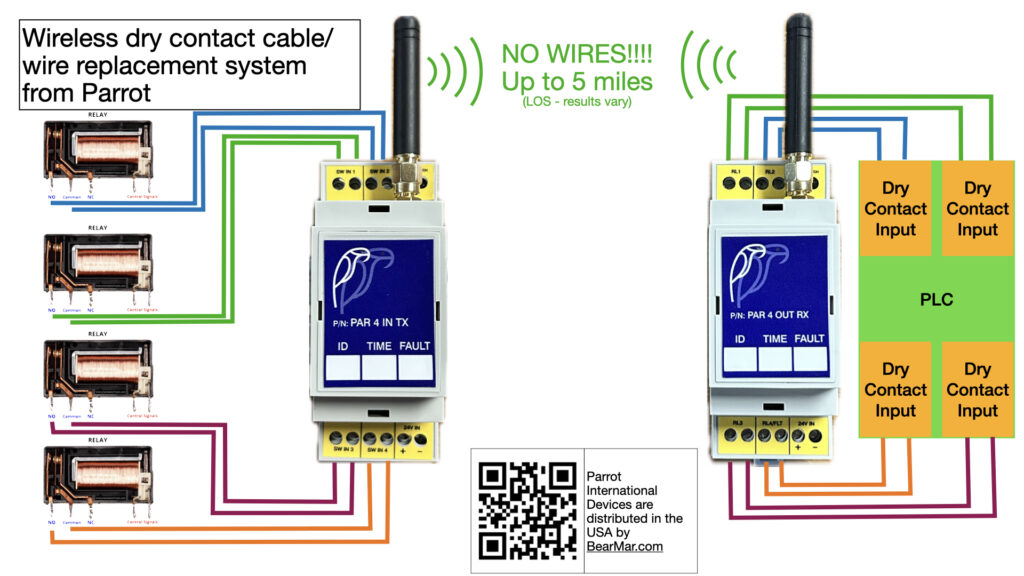
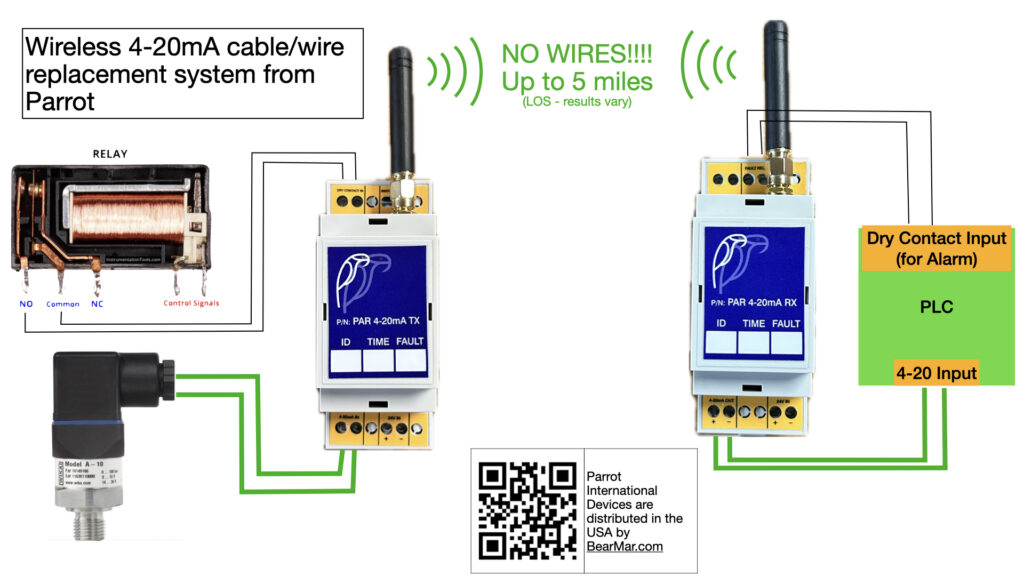
Oilfield and Wastewater Point to Point Products


Frequently Asked Questions
No. Point-to-point is a direct link. The receiver and transmitter are paired together with a robust military grade encryption (AES-128). The pair can coexist with many other pairs since the LoRa is designed to work in congested spectrum easily. Since this is the very same as a wire, you don’t have any fees monthly or ever because it is “just a wire”, albeit wireless.
The current signals supported are 4-20mA analog, dry contact signaling (on/off), and RS485/Modbus. The LoRa radio protocol doesn’t really care what is sent so other signals could be supported with a small engineering effort.
In the best case, up to 8 miles. If you tinker with the antennas, like add a Yahgi, you can get more. Of course all this is tempered by the LOS (Line of Sight) limitations that all radio systems have. As well, obstacles can impair the range as well. In short range applications, depending upon construction techniques, the LoRa signal can penetrate up to 12 walls. In my own experience, we are seeing ranges on the ranch without good LOS run about 1.5 to 2 miles. We are also seeing monitoring devices inside steel buildings as not being a big problem.
No. There are no recurring fees. The nature of the LoRa point-to-point configuration is that P2P LoRa does not require any infrastructure to operate. So no servers, no programming, no IT. It is so important to view the P2P LoRa as a true wireless wire. You only are replacing the wire.
These devices can operate using 24V power which can be generated locally using solar or other means. However, the power is minimal. BearMar makes a rugged ranch solar power system which is total overkill that could be used for power. However, there are probably much simpler ways to get 24V to the devices.
The big advantages are no sim cards, no data plans, no monthly fees, and no additional communications infrastructure. We’re just a “wireless wire”. We’re not trying to replace SCADA, we’re trying to replace the wires or replace more expensive radios with ones that will “do the job” splendidly.
If you don’t need to work with IT to run a wire, you should not need to work with IT to implement this wireless wire replacement. No infrastructure other than a 24V power is needed. It is just that simple.
No. The point-to-point receiver has a 4-20mA output and perfectly mirrors the remote 4-20mA sensor. You can choose different sampling periods based on how fast your data changes. For the dry contact sensors, the receiver will perfectly match the remote state of the dry contact signals.
No. You can keep your sensors. Nothing has to change at all for the remote transmitter end to work with the sensors you already use. You will need to supply 24V power, but that hopefully is a small sacrifice to not running those wires all over timbuktu.
It is very easy. Where you would have placed a wire, simply put a LoRa transmitter at the sensor end and a LoRa receiver at the PLC or controller end. It really is a “wireless wire”
Related Guides (internal links)
-
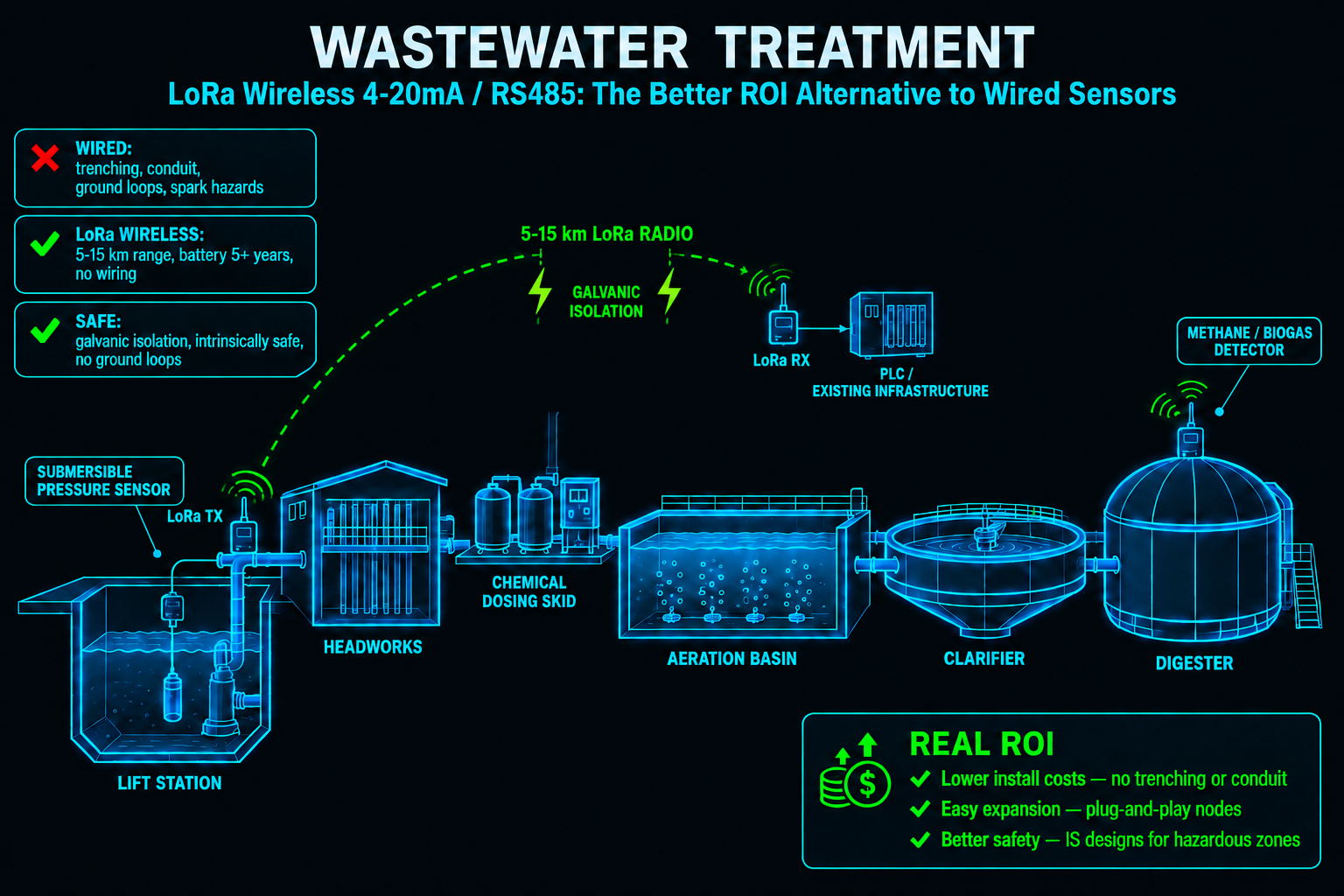
LoRa Wireless 4-20ma – RS485: The better ROI Alternative to Wired Solutions in Wastewater Treatment Facilities
Introduction Wastewater treatment facilities are critical infrastructure requiring reliable, real-time monitoring to ensure operational efficiency, regulatory compliance, and safety. Traditional wired sensor systems have long been the standard, but they come with significant drawbacks—high installation costs, inflexibility, and maintenance challenges. LoRa (Long Range) wireless 4-20mA sensors connectivity present a superior alternative, offering scalability, ease of…
-
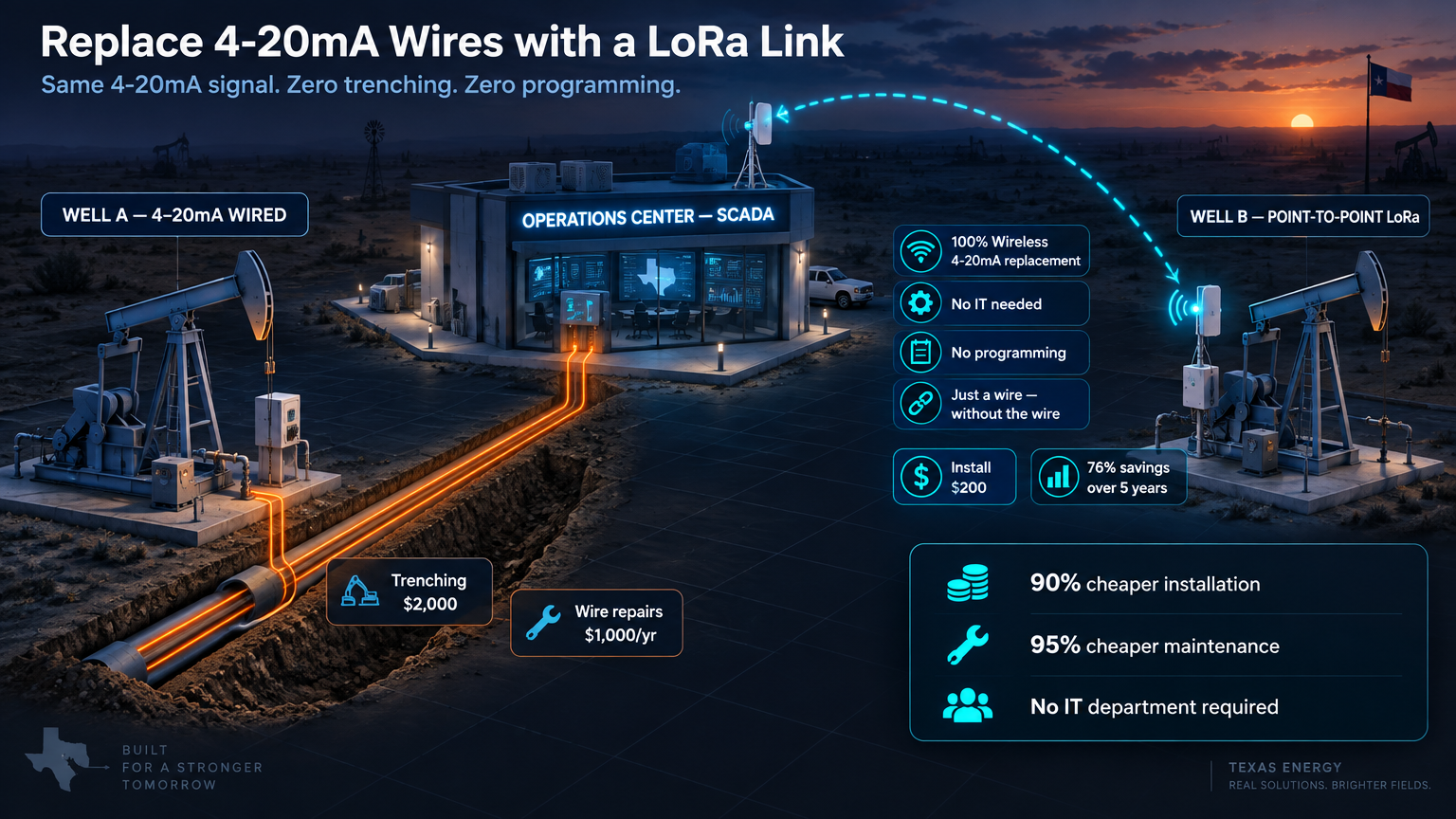
Cost Comparison: LoRa Wireless vs. 4-20mA Wired
(Based on a 10-sensor deployment in West Texas) Cost Factor 4-20mA Wired LoRa Wireless Savings Hardware (per sensor) $500 (transmitter + cable) $700 (LoRa transmitter) similar Installation Labor $2,000 (trenching/terminations) $200 (mounting + pairing) 90% cheaper Maintenance (annual) $1,000 (wire repairs) $50 (battery check) 95% cheaper SCADA Integration $3,000 (I/O card upgrades) $500 (gateway software)…
-
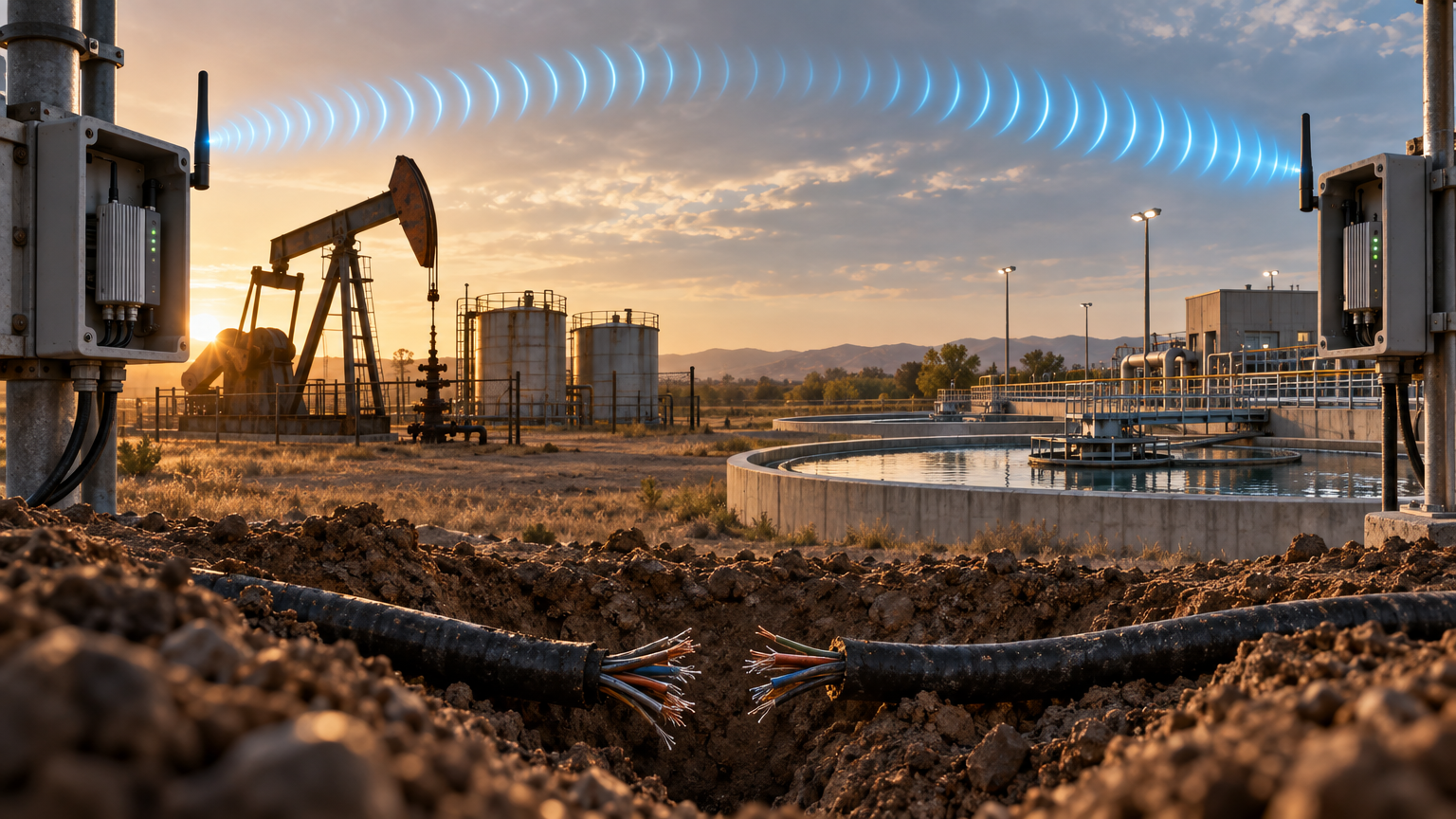
Texas Oilfield Case Studies
Case Study 1: Permian Basin Wireless Pressure Monitoring Case Study 2: Eagle Ford Shale Tank Level Monitoring Case Study 3: West Texas Pipeline Leak Detection 3. How to Get Started Step 1: Assess Your Current Sensors Step 2: Choose a Texas-Based Distributor Step 3: Pilot Test in a Small Section Step 4: Full-Scale Rollout Final…
-
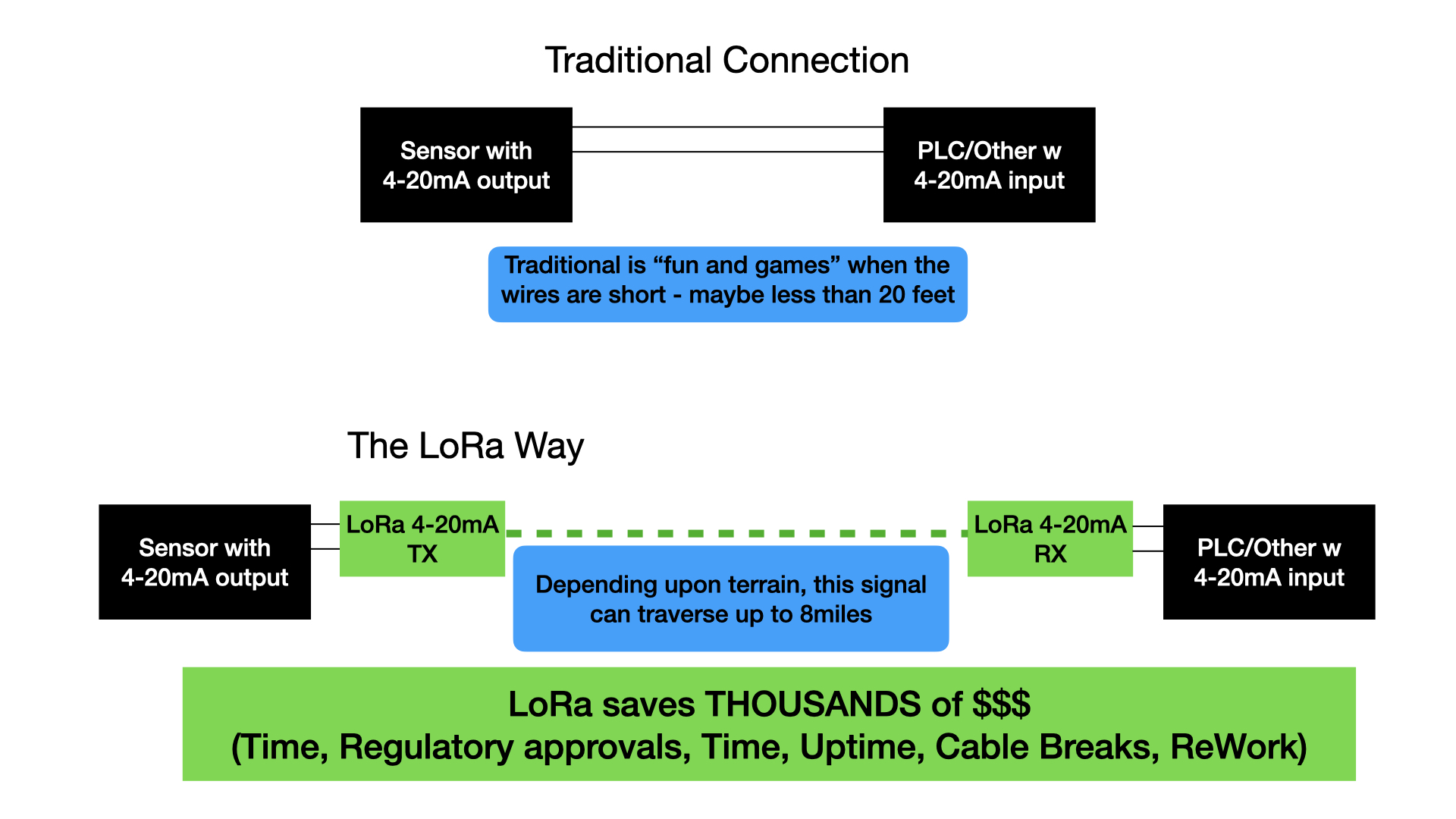
How Point-to-Point LoRa Replaces Expensive 4-20mA Current Loop Wiring in Industrial Applications
Introduction In industrial settings—especially oilfields, water treatment plants, and manufacturing facilities—4-20mA current loopshave long been the standard for transmitting sensor data (pressure, temperature, flow). However, trenching and running wires for these loops is expensive, time-consuming, and inflexible. Point-to-point LoRa wireless technology offers a cost-effective, reliable, and scalable alternative to wired 4-20mA loops. Unlike proprietary high-reliability radios (which are prohibitively…
-
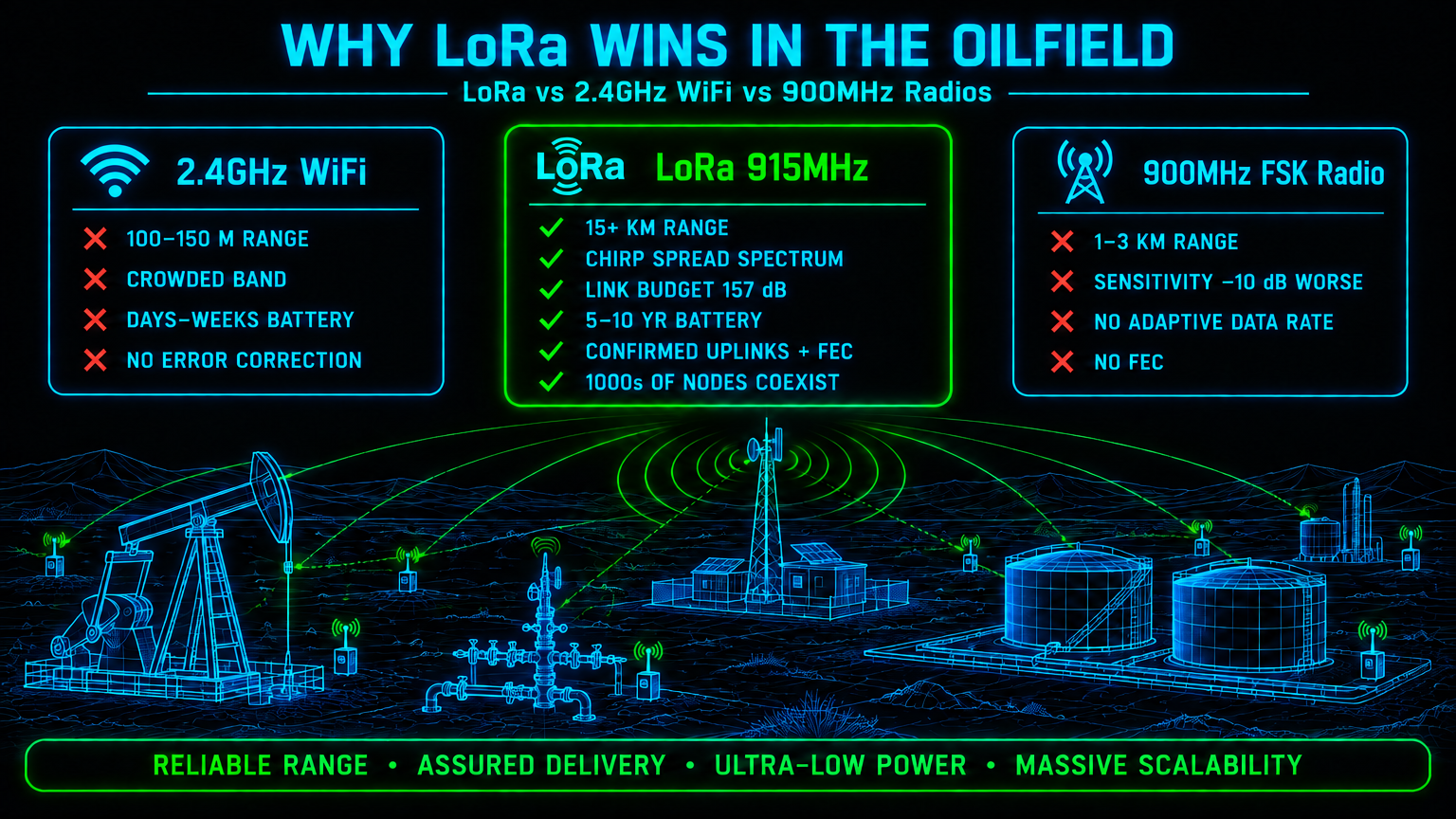
The Superiority of LoRa Radio Technology for Industrial Applications in the Oilfield
Introduction In industrial settings like oilfields, reliable communication is non-negotiable. Traditional wireless technologies such as 2.4GHz WiFi and non-LoRa 900MHz radios often fall short in harsh environments where interference, range, and power constraints are critical factors. LoRa (Long Range) radio technology stands out as the superior choice for industrial applications—especially for monitoring critical parameters like pressure via…