Beyond Wi-Fi: Why LoRaWAN is the Superior Choice for Industrial IoT and Agriculture
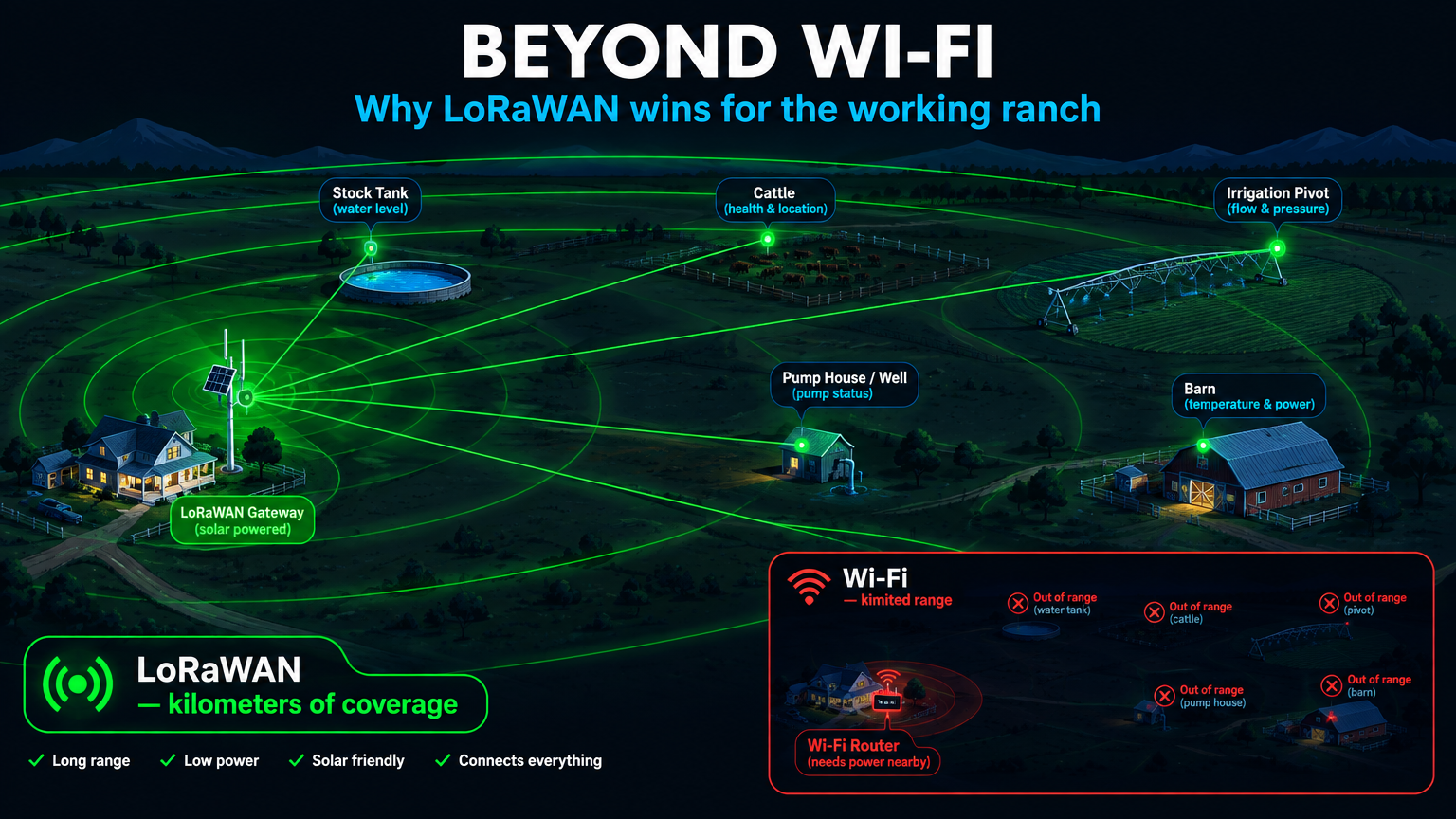
When designing custom electronic control systems—especially for agricultural or industrial environments—engineers often fall into the trap of choosing the path of least resistance. Because Wi-Fi is ubiquitous, cheap, and familiar, it is frequently the “go-to” protocol for IoT projects. However, as many have discovered the hard way, Wi-Fi is designed for the carpeted office or the living room, not the harsh, interference-heavy reality of industrial sensor networks.
If you are planning a long-term deployment for greenhouse automation, pump control, or telemetry, it is time to stop relying on Wi-Fi and start building with LoRaWAN.
The Case Study: The Greenhouse Pump Fiasco
Recently, I faced a challenge: managing seven hydroponic pumps sequentially. Running them simultaneously would have triggered a current surge, potentially tripping breakers or damaging the power supply. I needed a robust, customizable sequencer.
I selected a WaveShare Relay Board B paired with a Raspberry Pi Pico 2 W. The Pico W seemed ideal; it’s affordable ($7), it supports MicroPython (which I know well), and it features built-in Wi-Fi. My greenhouse is only 50 feet from my house, so I assumed I could easily send JSON telemetry to my Tago.io dashboard using WiFi.
Once the code was perfected, I deployed the unit. The result? Total failure. The Pico W simply could not maintain a reliable connection through building walls, distance, glass, and foliage. The signal strength was non-existent.
The Tactical Mistake
The error was foundational: I treated a consumer-grade protocol (Wi-Fi) as an industrial communication standard. Wi-Fi carries immense overhead and thrives in high-bandwidth, short-range environments. It is not designed for the penetration requirements of a humid greenhouse or the long-range needs of an agricultural field.
Why Wi-Fi Falls Short in Industrial IoT
If you are currently relying on Wi-Fi for your remote projects, here is why you are likely to experience signal drops and frustration:
- Poor Penetration: Wi-Fi struggles to pass through common industrial barriers like metal siding, thick glass, and dense vegetation. This is due to its high carrier frequency
- High Power Consumption: Constantly maintaining a Wi-Fi handshake wastes energy, which is a dealbreaker for remote, battery-powered setups.
- Range Limitations: Wi-Fi is typically reliable only within a 30–50 meter radius, especially in environments with high signal noise.
- Protocol Overhead: Wi-Fi is “chatty.” Devices spend significant power just keeping the network connection alive rather than sending data.
- Hard or Non Remote Setup: WiFi might not be difficult to setup, but compared to LoRaWAN it is quite involved and the setup must occur at the device, rather than at the network operations center.
The Solution: LoRaWAN
Instead of scrapping the project, I pivoted. I relegated the Pico 2 W to its strength—local timing and logic—and offloaded the communications to a Dragino LT-2222 LoRaWAN I/O Controller. The LoRaWAN unit wakes up the Pico, triggers the sequence, and handles the telemetry back to my existing LoRaWAN gateway.
The Advantages of LoRaWAN Over Wi-Fi and Cellular
| Protocol | Range | Penetration | Power Consumption | Best For |
|---|---|---|---|---|
| Wi-Fi | Short (30-50m) | Poor | High | Offices/Homes |
| Cellular | Unlimited | High | Medium/High | Remote, no-gateway sites |
| LoRaWAN | Long (2-5km+) | Excellent | Very Low | Agriculture/Industrial |
Why Not Cellular?
Many people ask why I didn’t simply use a 4G/5G cellular gateway. While cellular is reliable, it introduces unnecessary complexity and recurring costs.
Because I had already invested in a LoRaWAN infrastructure, the incremental cost of adding a node is essentially zero. Every additional sensor I add to my hydroponics operation costs only the price of the hardware, with no monthly subscription fees for data plans. It is the most cost-effective, scalable way to manage a large area.
Final Lessons for the IoT Builder
- Don’t let the $2 price difference fool you: While an Arduino might save you a few bucks, using hardware you are comfortable with (like the $7 Pico W) is fine as long as you recognize its limitations.
- Infrastructure matters: Once you build a LoRaWAN network, you have an infrastructure that pays for itself. It turns a “problem site” into a covered, data-rich zone.
- Think long-term: If you are operating outside of a climate-controlled home environment, Wi-Fi is not a reliable long-term solution.
If you want your projects to run autonomously without constant troubleshooting, stop reaching for the Wi-Fi chip. Invest in LoRaWAN, build your gateway, and spend more time watching your plants grow and less time debugging lost packets.
My hydroponic plants are doing splendidly, and my irrigation stays on schedule, 100% of the time, thanks to the inherent stability of the LoRaWAN protocol.
0 Comments