Bridging the Gap: A Comprehensive Guide to Connecting LoRaWAN Networks to the Internet
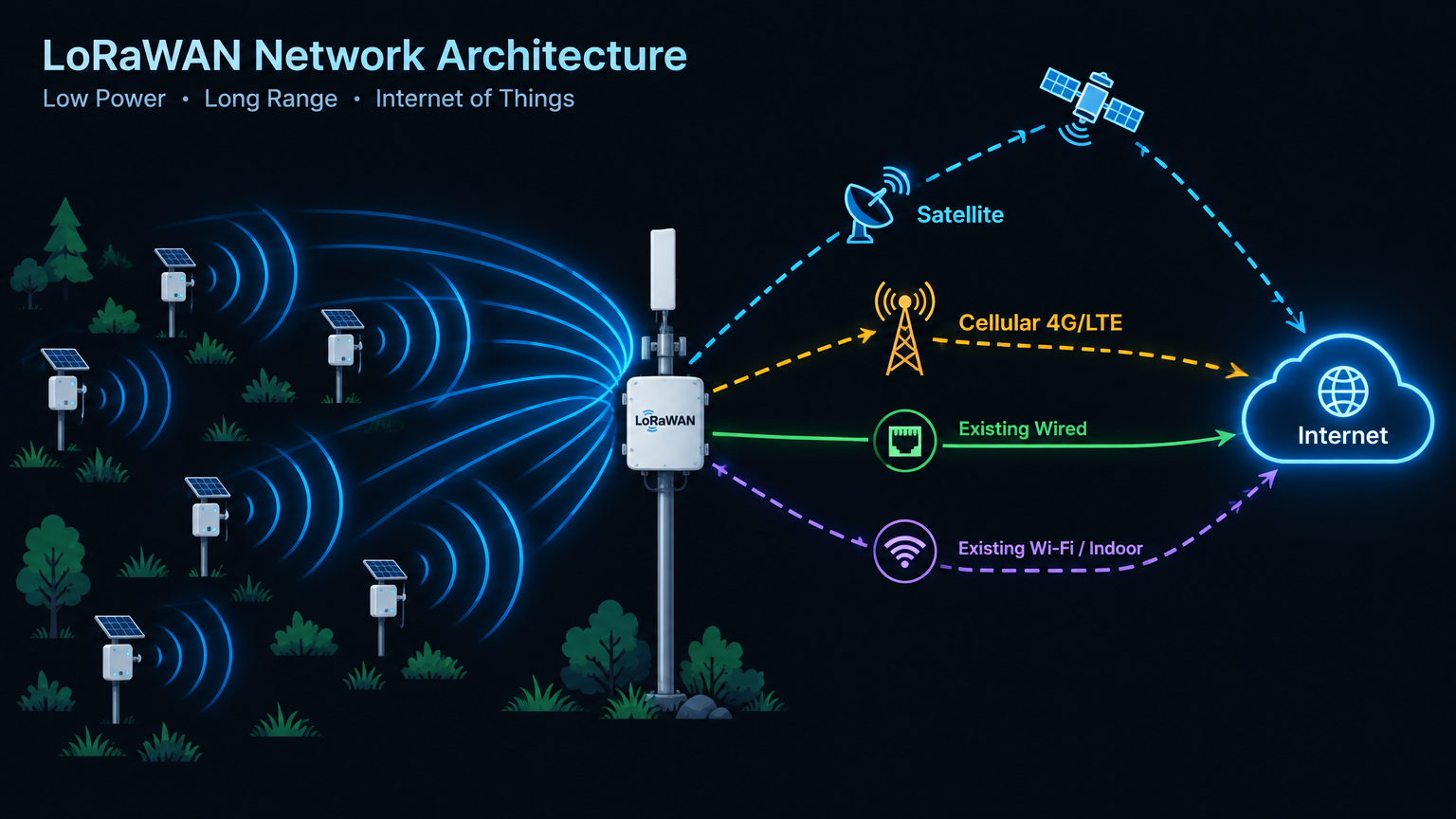
The beauty of LoRaWAN lies in its incredible range and low power consumption, allowing sensors to operate for years on a single battery. However, a LoRaWAN sensor is only as good as its gateway connection. While the sensor talks to the gateway via sub-gigahertz radio, the gateway must effectively “backhaul” that data to the network server, and ultimately, to your dashboard.
Choosing the right backhaul method is a strategic decision that balances infrastructure cost, reliability, and deployment complexity. Below, we compare the four primary methods for connecting your LoRaWAN infrastructure to the internet.
Comparison of LoRaWAN Backhaul Methods
| Method | Complexity | Cost per Node | Admin Ability | Error Avoidance |
|---|---|---|---|---|
| Satellite | High | High | High | Excellent |
| Cellular (4G/LTE) | Medium | Medium | High | Excellent |
| Existing (Outdoors) | Low | Low | Medium | Fair |
| Existing (Indoors) | Very Low | Low | Low | Poor |
1. Satellite Bandwidth to Outdoor Gateway
Satellite backhaul is the gold standard for remote asset monitoring where terrestrial networks (cellular or fiber) do not exist. Using LEO (Low Earth Orbit) providers like Starlink, you can bring high-speed internet to the most desolate environments.
Pros:
- Unrivaled Coverage: Can be deployed anywhere on Earth with a clear view of the sky.
- Network Isolation: Runs completely independent of local infrastructure—if the power grid fails, your satellite-backed gateway remains online.
- High Reliability: Ideal for critical infrastructure like oil pipelines or remote agricultural monitoring.
Cons:
- Expensive Hardware: Requires specialized satellite terminals and high-power mounting equipment.
- High Monthly OpEx: Satellite data plans are generally significantly more expensive than cellular or wired alternatives.
- Logistical Challenge: Requires significant power budget (often requiring solar arrays or wind turbines).
2. Cellular Bandwidth (4G/LTE/5G) to Outdoor Gateway
Cellular backhaul is the most popular choice for commercial and industrial IoT deployments. By utilizing an industrial LTE router mated to a gateway, you create a standalone, high-performance node.
Pros:
- Plug-and-Play: Many outdoor gateways now come with integrated cellular modems.
- Remote Management: Allows for OOB (Out-of-Band) management, meaning you can reboot the gateway or update firmware without visiting the site.
- Scalable: Deploying in a new area is as easy as securing a site and powering it up.
Cons:
- Reliance on Carriers: You are at the mercy of cellular network maintenance and signal congestion.
- Data Caps: While IoT data is small, large network updates can lead to overage charges if not managed correctly.
3. Existing Bandwidth to Outdoor Gateway
This method utilizes a fixed-line internet connection (fiber, cable, or DSL) at an industrial site and extends it to an outdoor gateway via Ethernet or Wi-Fi bridge.
Pros:
- Cost Effective: You are leveraging existing infrastructure you are already paying for.
- Low Latency: Fiber-backhauled gateways provide the most responsive data transmission.
- High Bandwidth: No concerns about data caps.
Cons:
- User/IT Errors: If someone in the building updates firewall rules or changes the Wi-Fi password, your gateway goes dark.
- Hardwired Limitations: Often restricted by cable length limitations (100m for standard Ethernet) unless fiber extenders are used.
4. Existing Bandwidth to Indoor Gateway
This involves placing a low-cost, plug-and-play LoRaWAN gateway inside an office or residence and connecting it to the local Network.
Pros:
- Easiest Deployment: Often involves simply plugging a device into the router and a standard wall outlet.
- Lowest CapEx: These gateways are often very inexpensive because they don’t require weatherproofing or cellular hardware.
Cons:
- High “Human Factor” Risk: High probability of connection loss due to office moves, router resets, or non-technical staff unplugging the device.
- Signal Dampening: Walls and building materials significantly degrade the signal, limiting the reach of the LoRaWAN network.
- Security Concerns: Placing IoT hardware on the same network as sensitive corporate data can present a cybersecurity risk if not properly segmented via VLANs.
Strategic Recommendations
If you are building a critical industrial network, always prioritize Cellular or Satellite backhaul. While these incur higher monthly costs, the ability to remotely administrate the gateway and avoid the “human element” of local network changes saves thousands in truck-roll costs over the lifetime of a project.
For campus-wide deployments or smart buildings, using existing bandwidth is acceptable, provided that you treat your gateways as managed assets. Ensure they are on a dedicated IoT VLAN and are equipped with a hardware-based “Watchdog” timer to ensure they reboot automatically if the internet connection drops.
Ultimately, the goal is to decouple the gateway’s performance from the unpredictable nature of local user activities. By selecting a backhaul method that offers high visibility and control, you turn your IoT deployment from a headache into a robust, high-uptime digital asset.
0 Comments