Navigating the IoT Landscape: Choosing the Right Connectivity for Sensors and Actuators
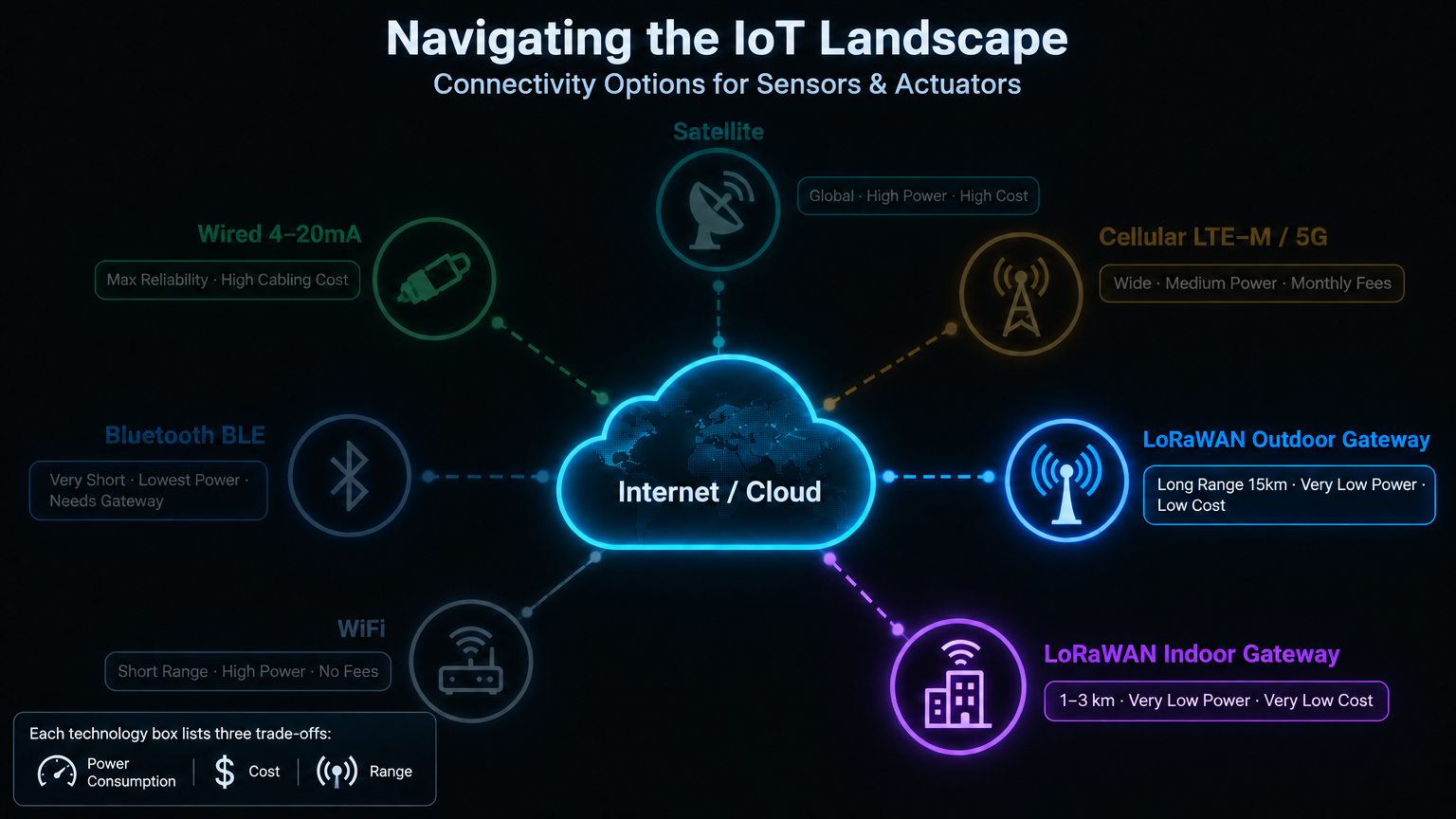
In the rapidly evolving world of the Industrial Internet of Things (IIoT), the method you choose to connect your sensors and actuators to the internet is the single most important architectural decision you will make. Whether you are monitoring oil pipelines in the middle of a desert, managing a smart warehouse, or automating a manufacturing floor, the connectivity stack determines your power efficiency, operational costs, and total system reliability.
Connectivity is not a “one size fits all” endeavor. It is a balancing act between power consumption, hardware investment, data bandwidth, and geographical coverage. This guide breaks down the primary methods for connecting sensors and actuators to the internet to help you architect a robust, cost-effective solution.
Comparison of Connectivity Methods
The table below summarizes the trade-offs between the primary connectivity technologies.
| Technology | Power Consumption | Hardware Cost | Connection Cost | Range |
|---|---|---|---|---|
| Satellite | High | High | High | Global |
| Cellular (LTE/5G) | Medium-High | Medium | Medium | Wide (Cell coverage) |
| LoRaWAN (Outdoor GW) | Very Low | Medium | Low | Long-Range |
| LoRaWAN (Indoor GW) | Very Low | Low | Very Low | Moderate (1-3km) |
| WiFi | High | Low | None (Local) | Short |
| Bluetooth (BLE) | Lowest | Low | None (Local) | Very Short |
| Wired (4-20mA) | N/A (Powered) | High (Cabling) | None | Limited by Cable |
1. Satellite-Based Sensors
Satellite connectivity provides true global reach. It is the final resort for remote operations where no cellular or terrestrial infrastructure exists.
- Pros:
- Unrivaled coverage: Reachable anywhere on Earth.
- Independence: No依赖 (reliance) on local terrestrial infrastructure.
- Cons:
- Extremely high power consumption due to high-gain signal transmission.
- Significant recurring data costs.
- High initial investment in specialized hardware.
2. Cellular-Based Sensors (LTE-M, NB-IoT, 5G)
Cellular connectivity is the standard for mobile or distributed assets that fall within populated areas.
- Pros:
- Robust bandwidth capabilities for firmware updates.
- Ease of deployment (plug-and-play).
- Excellent security standards maintained by telecommunications providers.
- Cons:
- Recurring monthly subscription fees for every device.
- Higher power draw compared to LPWAN (Low Power Wide Area Network) protocols.
3. LoRaWAN (Outdoor Gateway)
LoRaWAN uses unlicensed spectrum to transmit data over long distances with minimal power. An outdoor gateway is usually mounted on a mast to maximize visibility and range.
- Pros:
- Incredible range (up to 15km in rural settings).
- Low power consumption: Battery life can span years.
- Low cost of ownership (no per-device recurring subscription).
- Cons:
- Requires a “Backhaul” (Cellular/IP) to link the gateway to the cloud.
- Lower throughput compared to WiFi or Cellular.
4. LoRaWAN (Indoor Gateway)
Similar to the outdoor version, this is optimized for smart buildings, campuses, or dense warehouse environments.
- Pros:
- Optimized for high-density sensor networks in contained areas.
- Very low cost to implement.
- Great penetration through wall structures.
- Cons:
- Limited physical range compared to outdoor high-gain gateways.
- Still requires backhaul to the enterprise network.
5. WiFi-Based Sensors
WiFi is ubiquitous. If you have an existing robust WiFi network, using it for sensors seems intuitive, though it comes with limitations.
- Pros:
- Very cheap and easy to integrate with existing IT infrastructure.
- High bandwidth for high-definition video or complex data.
- Cons:
- Not designed for long-term battery operation due to high idle power drain.
- Congestion issues in areas with many connected devices.
6. Bluetooth Connected Sensors (BLE)
Bluetooth is effectively a local-area protocol. While convenient for personal metrics, it is not a “serious” connection for industrial infrastructure unless paired with a gateway.
- Pros:
- Ultra-low power consumption.
- Extremely low hardware costs (standard components).
- Cons:
- No internet protocol by itself; requires a smartphone or dedicated gateway to bridge data.
- Extremely short range.
7. Wired Connections (4-20mA Current Loops)
The gold standard for reliability in heavy industrial environments like processing plants or refineries.
- Pros:
- Immune to RF interference (unlike wireless radios).
- Maximum data reliability and latency.
- Cons:
- Exorbitant installation cost due to manual cabling requirements.
- Poor scalability; once the wires are run, adding new nodes involves moving heavy infrastructure.
Time needed: 2 hours
- Determine your required monitoring needs.
The first thing is to ask yourself – Do I need to monitor a single thing and not much else OR do I have several things to monitor in the geography.
- Understand your geography
You need to have awareness of your geography. If you are hilly and need to connect many devices versus hilly and only have a single thing to monitor will product different decision.
- Combine Geography and Monitoring Needs
Combining, in your mind, the geography and the monitoring needs will help you determine the scope of your problem. More importantly, it can and will lead to a decision on the best approach to selecting bandwidth or your internet connection so that you can remotely monitor whatever it is you want to monitor.
- Select Your Bandwidth Based on Prior Steps
The first thing is to ask yourself – Do I need to monitor a single thing and not much else OR do I have several things to monitor in the geography. Once you decide that you HAVE to use satellite – for example – there is no cell coverage – then the narrows the choices substantially. It may well be that getting a Ridgebeamer and then converting satellite to LoRaWAN is still a better solution.
- Contact BearMar and Present you Situation
BearMar would be happy to consult with you on different solutions. BearMar expertise is LoRaWAN for sure, but if your solution should be cellular only (no LoRaWAN), we’ll tell you straight up. It is better to do the right thing than try to win the wrong thing.
Conclusion: Making the Right Choice
When architecture, longevity, and budget collide, the answer is usually found by evaluating the total cost of ownership (TCO).
For large-scale, remote operations, LoRaWAN is currently the industry leader due to its balance between low power consumption and long-range connectivity. If you require high-bandwidth data, Cellular (LTE-M) is the most mature path forward. For static, high-reliability industrial automation, the traditional wired 4-20mA approach remains the king of stability. Avoid Bluetooth-only solutions for enterprise-grade projects, as they lack the physical infrastructure to transport data across an internet-facing network.
By carefully matching these technologies to your environment, you ensure a system that is not only functional today but scalable for the challenges of tomorrow.
0 Comments