Description
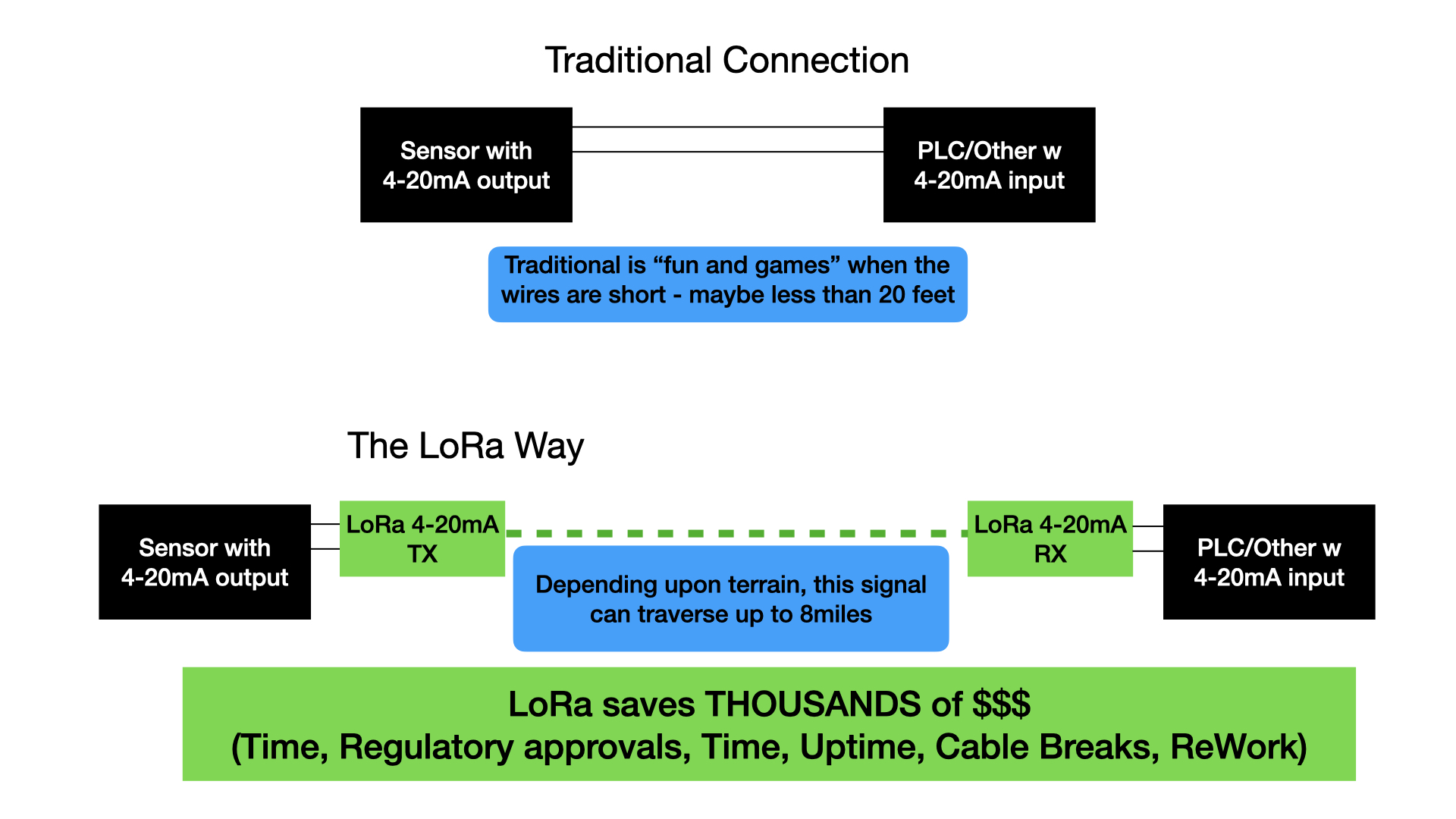
Eliminate EXPENSIVE SCADA radios or EXPENSIVE cable trenching between 4-20ma current loop sensors and programmable logic controllers.
No gateway, No license, No sim, No IT, No programming Needed
Using the BATTLE HARDENED, TRIED AND TESTED, LORA (LOng RAnge) wireless protocol, now you can eliminate cable runs of up to 8 miles (or 15km). Of course the LORA loves line of site, but this is also a low frequency spread spectrum technology that can penetrate walls easily. Of course any obstacle reduces the range. This isn’t silly “toy band” radio, this is a spread spectrum frequency hopping radio system that can handle demanding environments.
These are viable alternatives to the SCADALink SR900 or RIO900 except the protocol (LoRa) is named and not a secret.
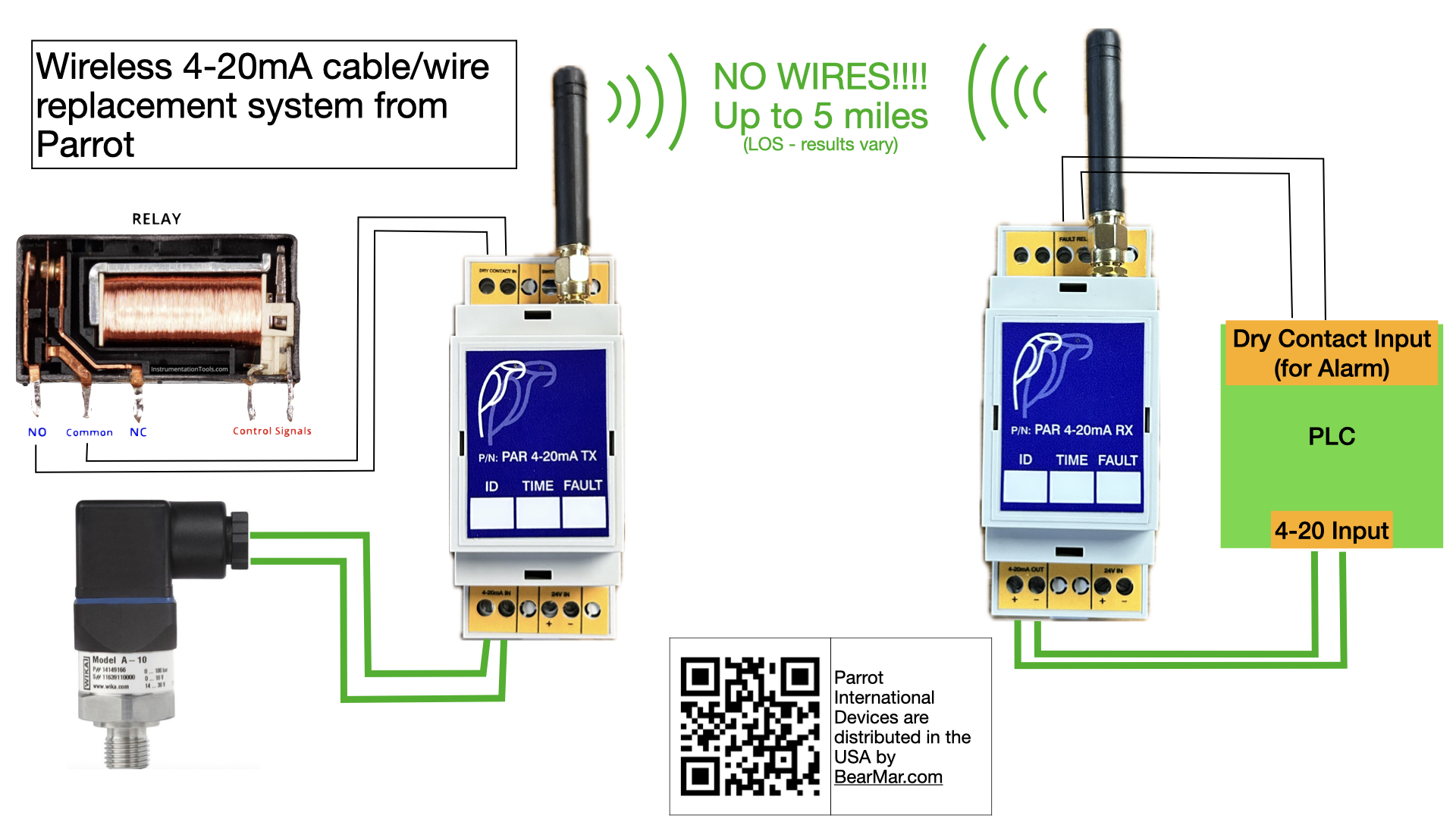
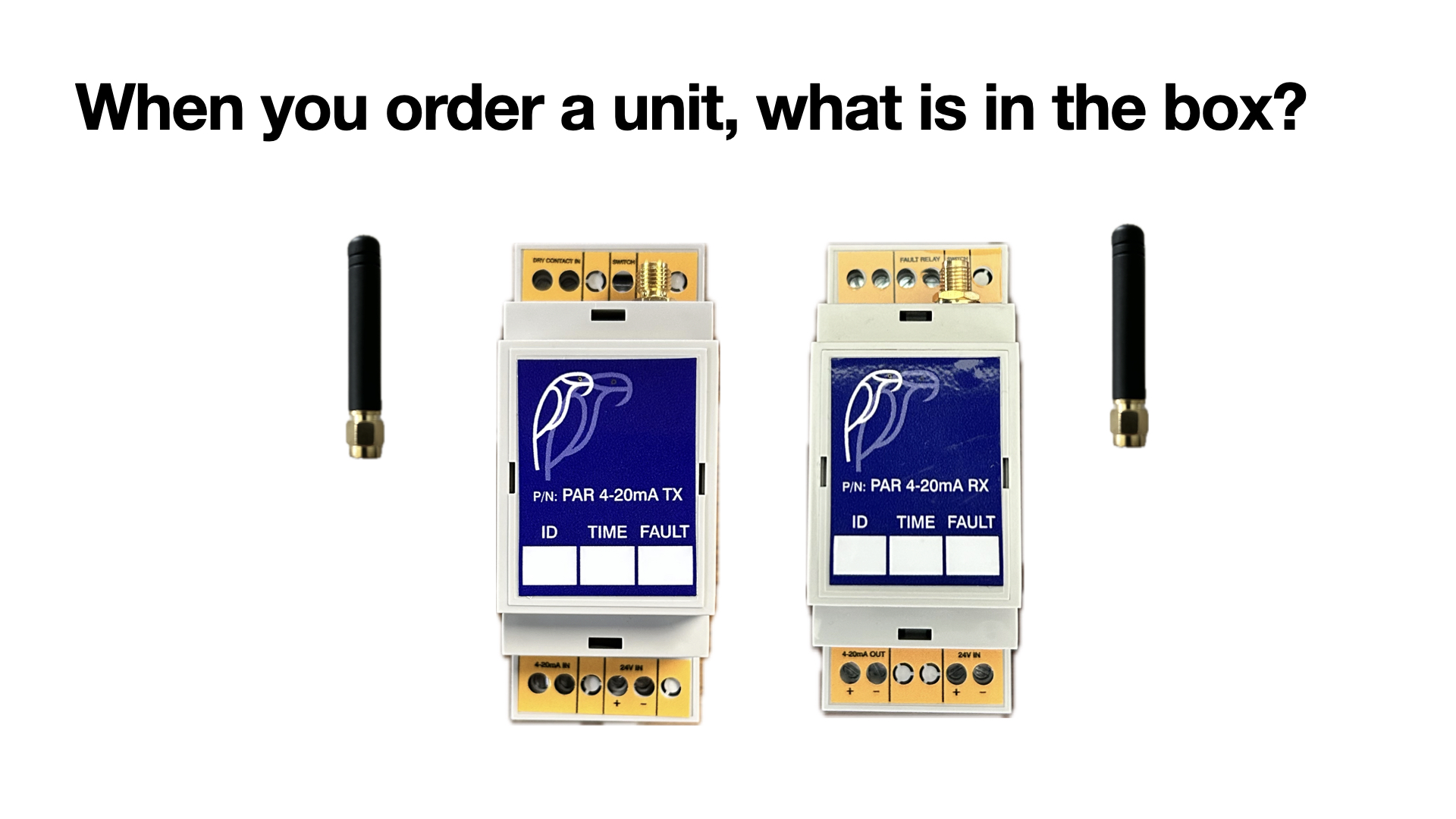
Each WIRELESS 4-20mA cable replacement consists of a PAIR of endpoints, one end a 4-20ma transmitter and the other end a 4-20ma receiver. They are interconnected by the LORA wireless technology.
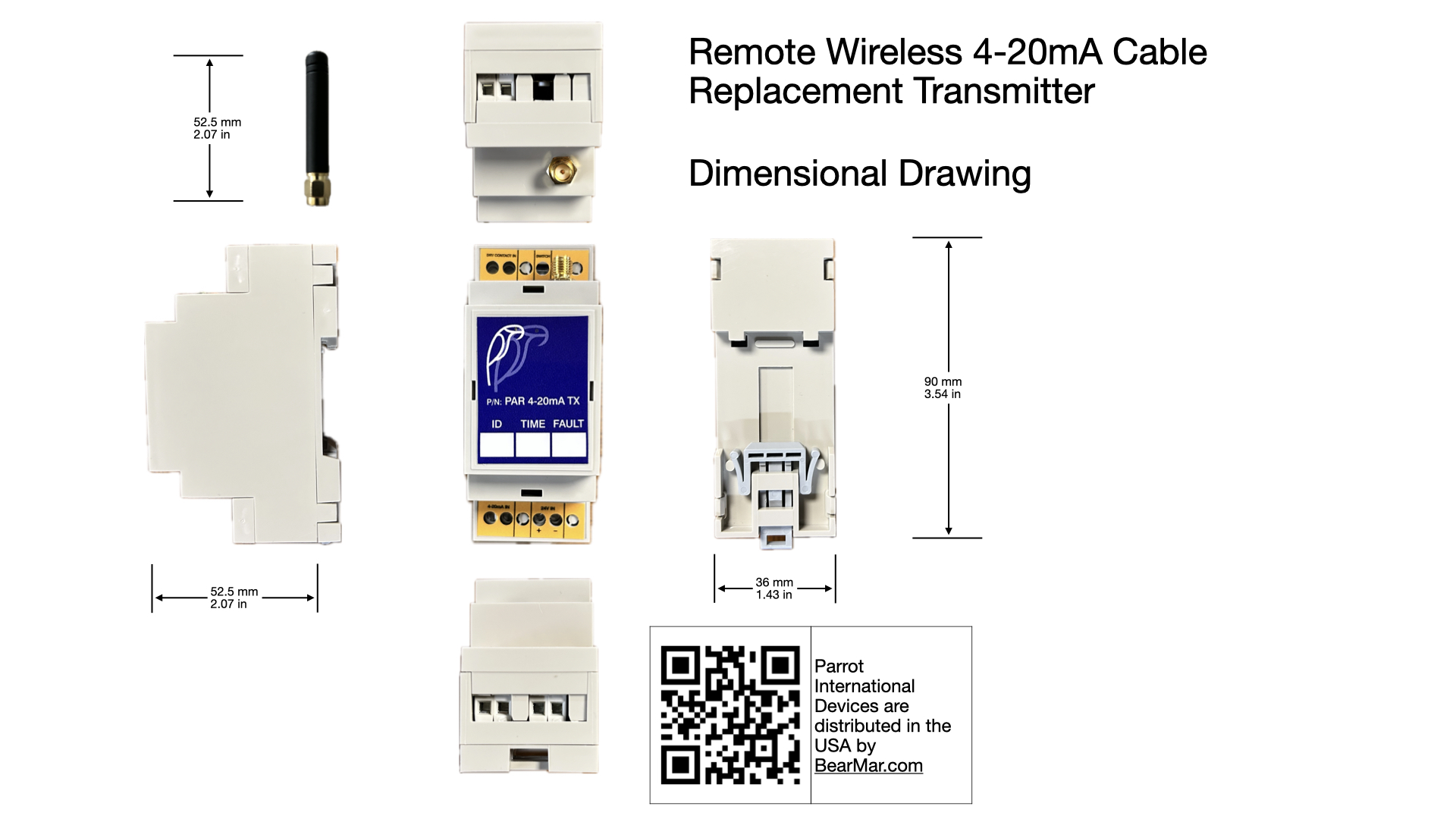
4-20mA Transmitter Unit – Attaches to your regular trusted Sensor or Remote Unit
- Connections
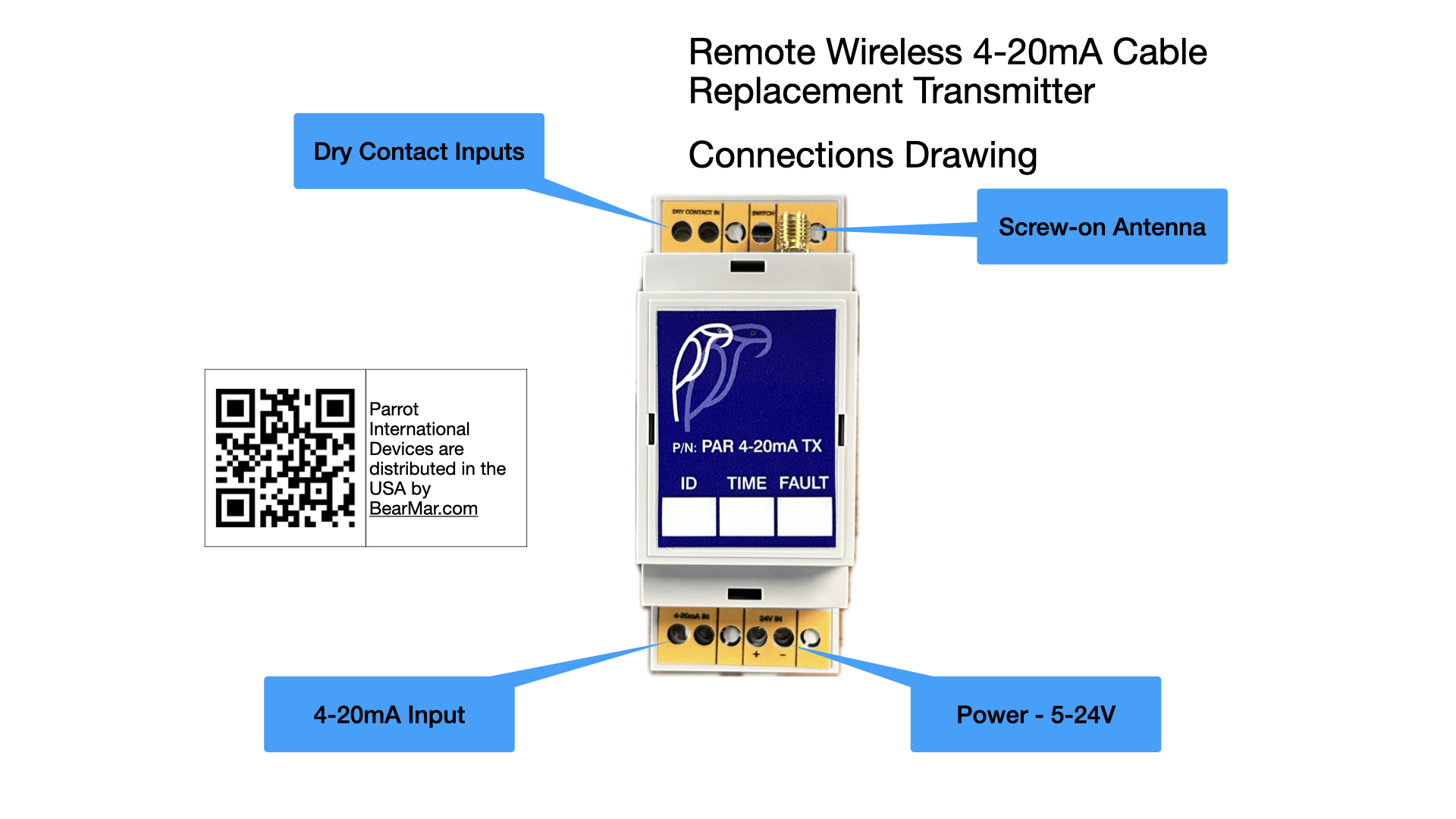
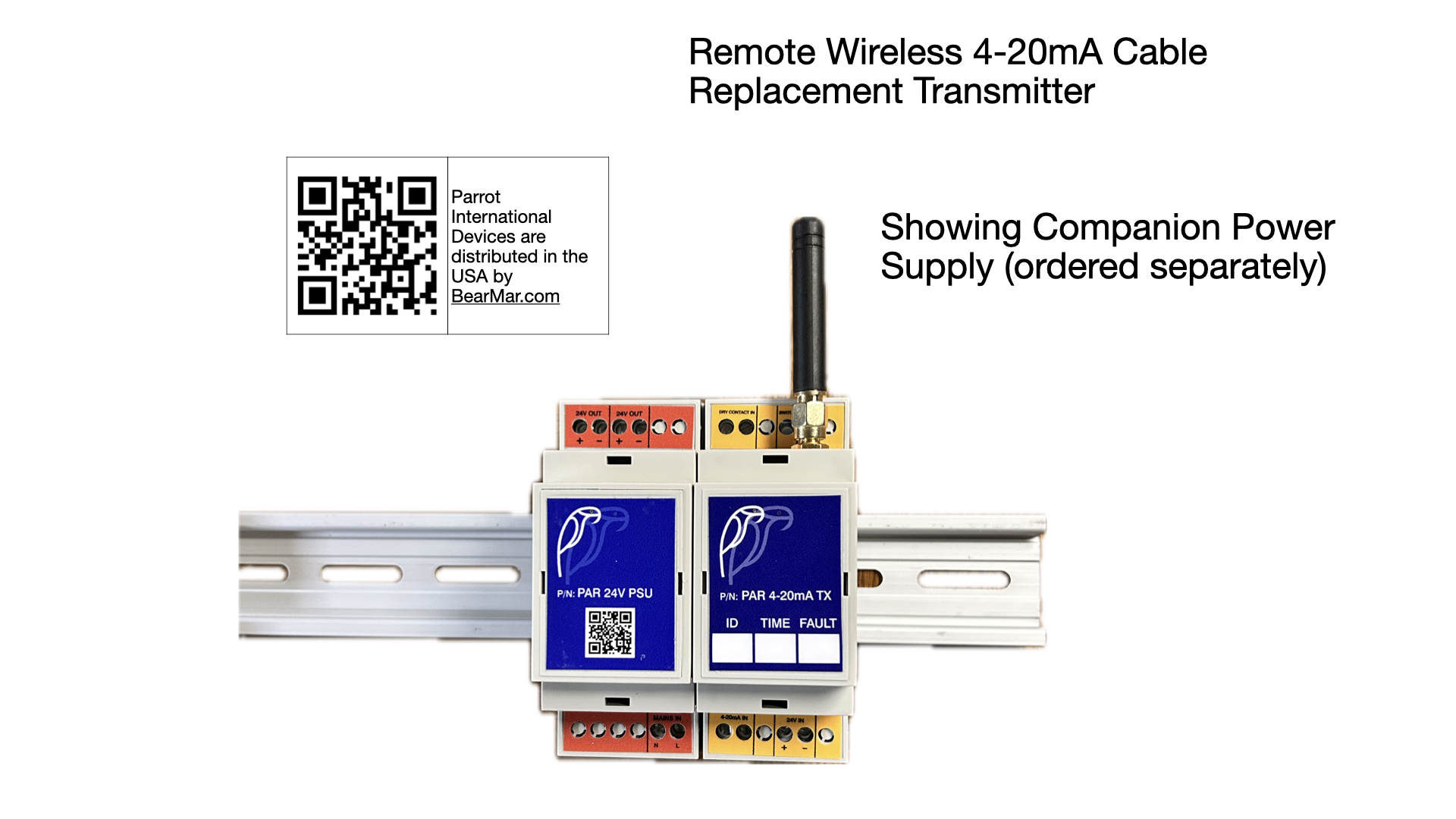
- 5-24V DC input for power ( 140mA per transmission / 30mA in idle )
- Dry Contact Relay Sense/Read – Use for fault detection – send fault signal to PLC/SCADA wirelessly
- 4-20 mA Sensor connection – Connect to the sensor normally – samples sensor periodically
- Paired with a Receiver Unit – – One TX unit + one RX unit replaces one wire.
- This is the end that connects to a standard 4-20mA sensor
- On a period basis that is adjustable (standard is 1 min) the transmitter checks the sensor and then transmits the 4-20mA current level
- Many of these remote transmitters are powered by small solar installations (you can find easily on Amazon, etc.)
- Recommended Solar Panel : 10-20W
- Recommended Energy Storage: 50W-100W Hour LifePo4 Battery – Probably overkill, but you want to be sure
- Recommended Charge Controller: Charge Controller : Size to the panel. Max load current never more than 0.2Amp (this is conservative)
- Compatible with:
- Any 4-20 mA sensor
- WIKA USA Industrial Pressure Sensors
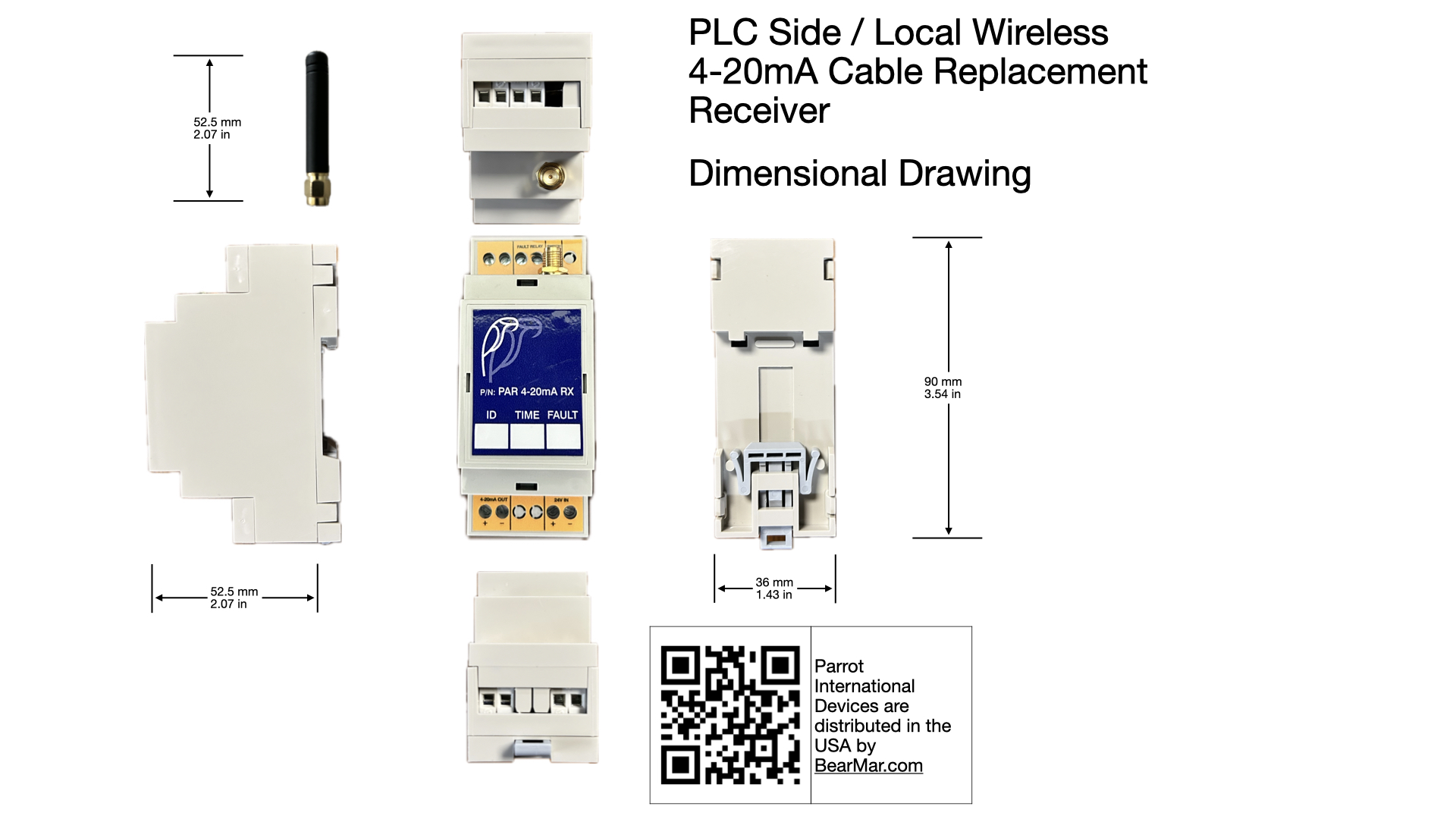
4-20mA Receiver Unit – Attaches to your regular trusted PLC, Aggregation Point, or Computer
- Connections:
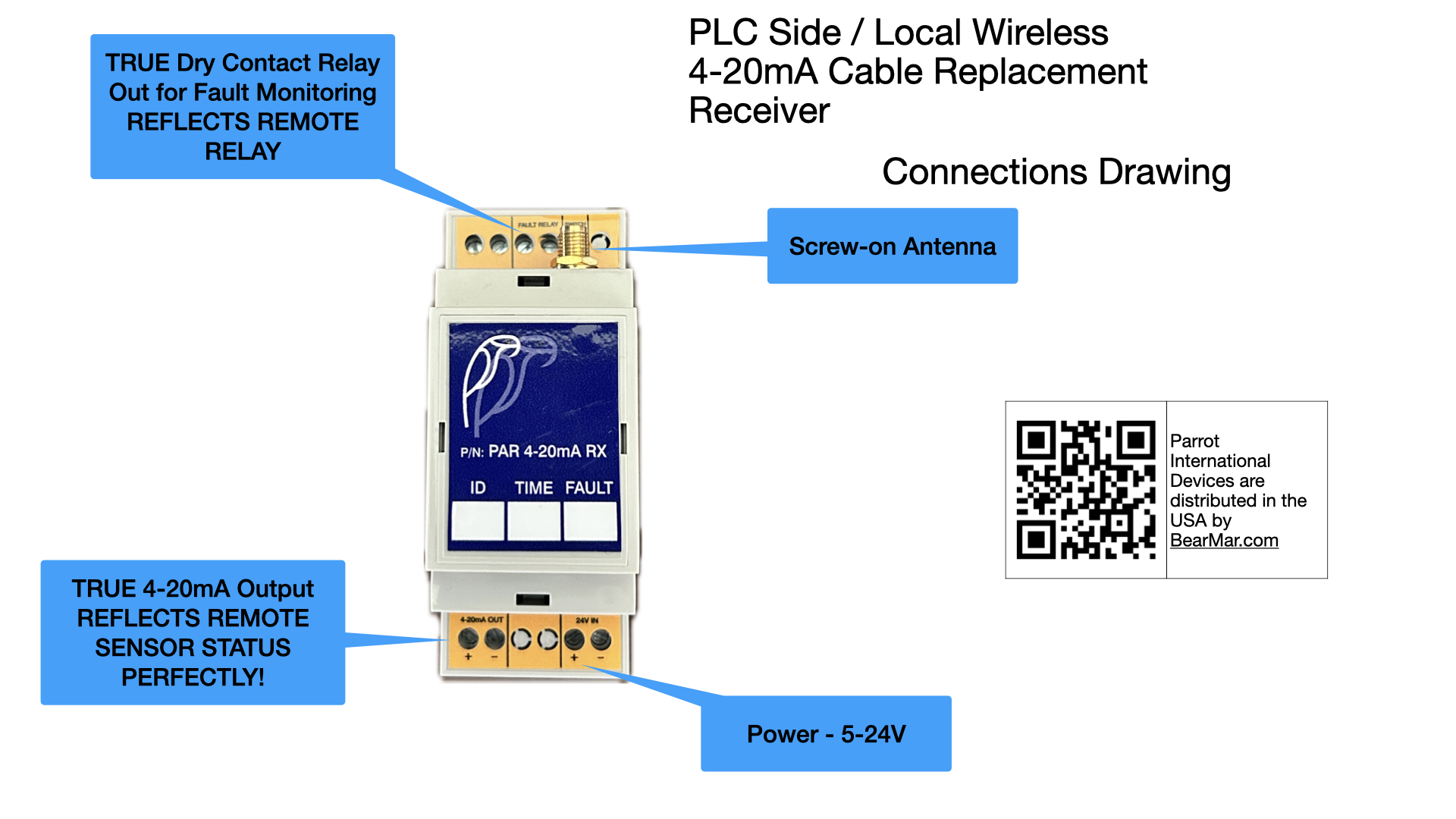
- 5-24V DC input ( 140mA per transmission / 30mA in idle )
- 4-20 mA Output – A perfect “reflection” of the remote 4-20 mA sensor value
- Fault Relay Output –
- reflects relay status of remote dry contacts
- True relay output – not “just digital”
- also triggers if transmissions are not detected
- Paired with a Transmitter Unit – One TX unit + one RX unit replaces one wire.
- This is the end that connects to a standard 4-20mA receiver such as a 4-20ma to RS485 converter or a PLC
- On a period basis determined by the Transmitter Unit, this receiver receives the 4-20mA current level digitally and then provides a 4-20ma signal that is an exact mirror of what the Transmitter Unit detected. Very cool
- Generally, the wireless 4-20mA cable receiver will have power on its end as it is close to many devices which utilize the 4-20mA inputs for a control system.
4-20mA Transmitter and Receiver Unit – Key Notes
- Both Units
- See the 4-20 wireless quick start guide to understand in more detail.
- 1000’s of units can be operating simultaneously in an area without interference.
- ISM Frequency Bands 915MHz (USA)
- FCC Certified (USA) & IC (Canada) requirements
- CE marked
- RoHS compliant
- DIN Rail Mounts
- Professionally Molded Case with custom fit electronics
- This product is built for scale production
- This can replace UP TO 8 miles of buried or conduited 4-20mA wiring. Of course this is the absolute optimal range, so you should expect less if you don’t have perfect line of sight.
Use Cases for the 4-20mA wireless cable replacements
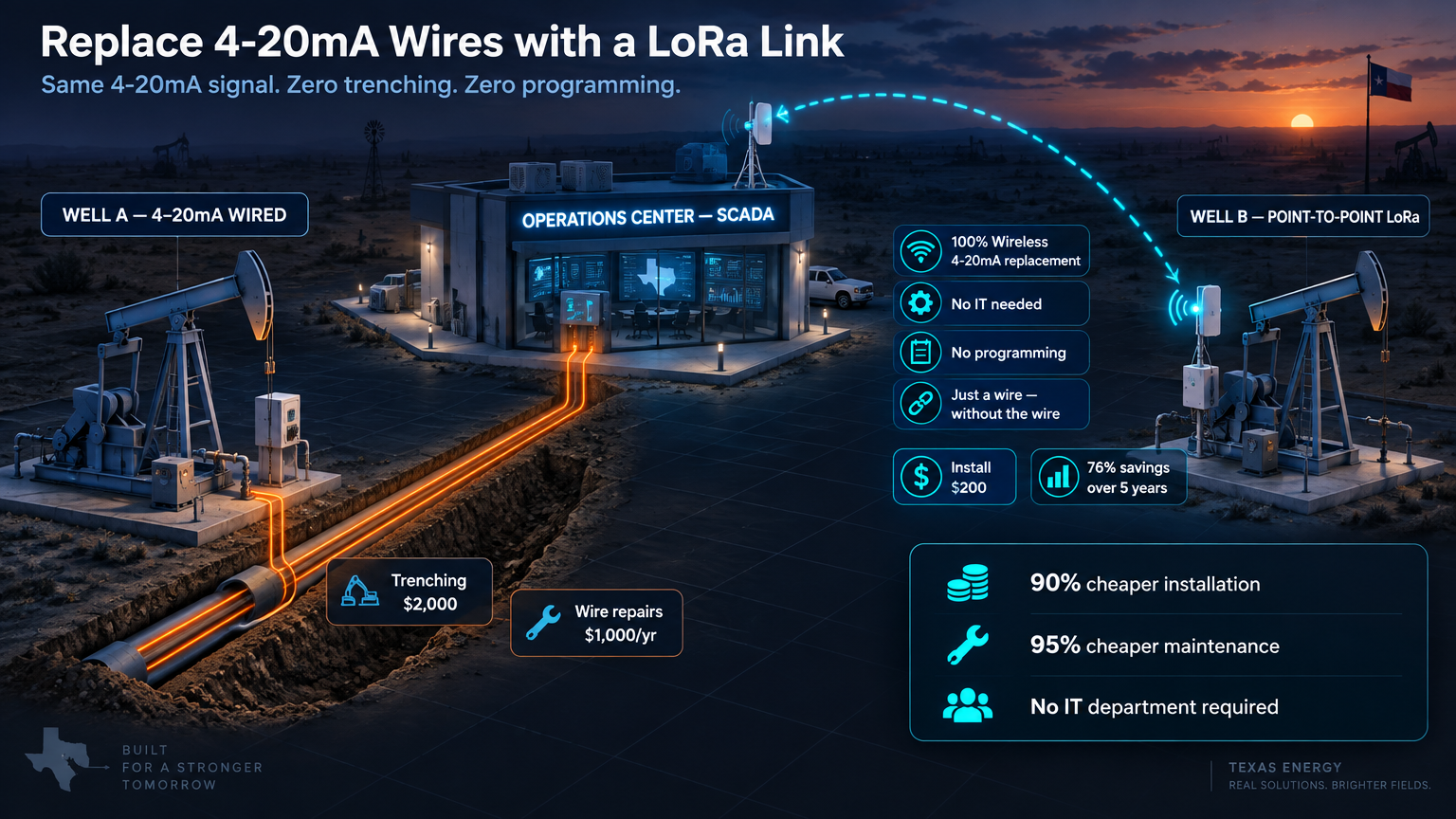
- Oilfield Monitoring
- Wells are located a distance from the datamonitoring point
- Wellhead pressure, pipe pressure, remote temperature
- Integrate within SCADA systems
- MINIMIZE DOWNTIME DUE TO BROKEN WIRES
- Keep 5-10 of these units in stock at each “plant” for reduced downtime
- Replace the broken wires with this product.
- Eliminate pulling replacement wire.
- Eliminate finding the break
- REDUCE THE COST OF NEW PLANTS
- No trenching for 4-20 sensors
- No separate wire runs in trenches with oil or water pipes
- Eliminate the wire run planning, conduit-ing, and difficulties of running wire.
- Rapid reconfiguration.
- Wells are located a distance from the datamonitoring point
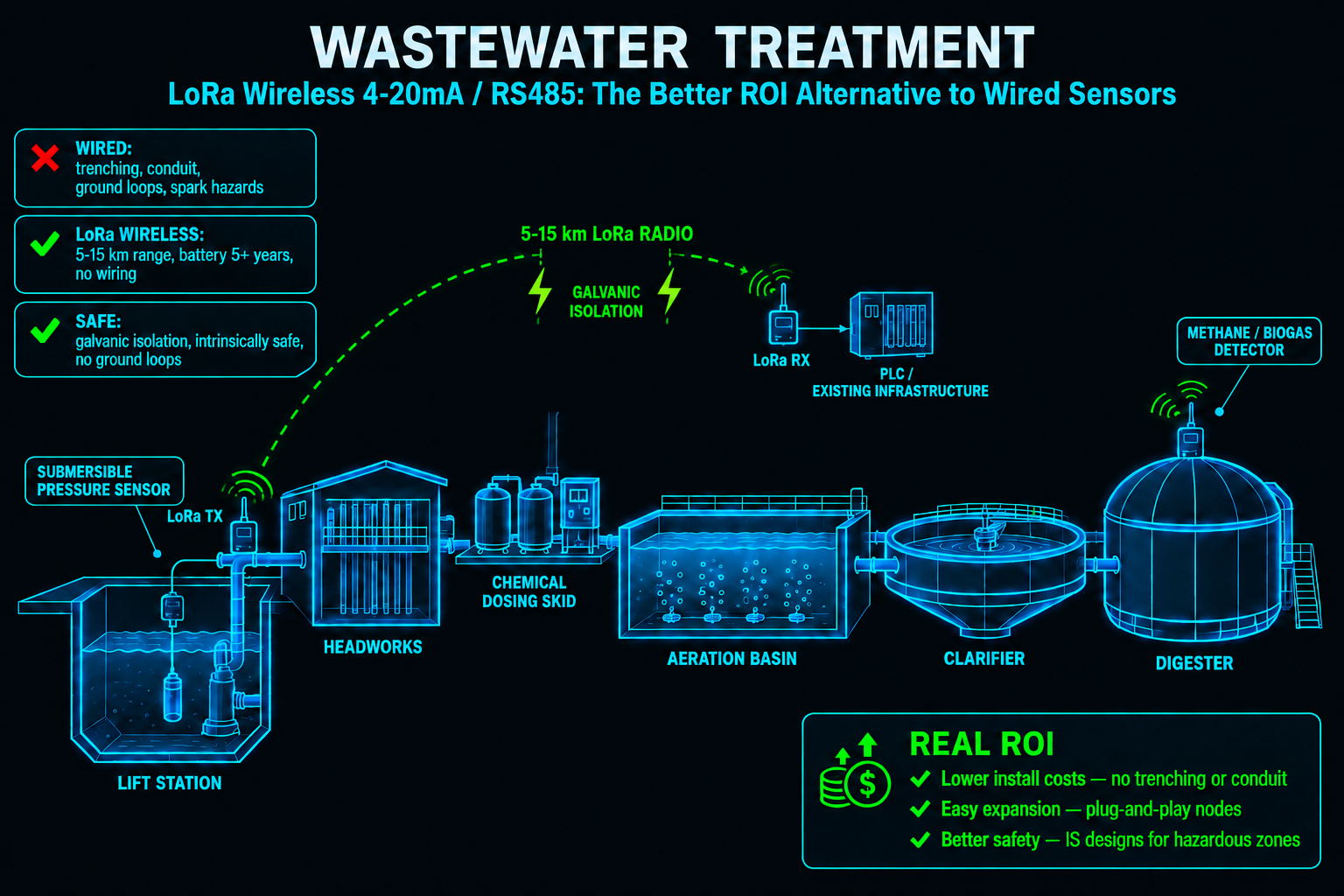
- Wastewater Treatment Facilities
- Concrete Containments make digging and re-work impossible.
- NO wires, means NO conductive wires/surfaces to create dangerous situation or short circuits
Why this 4-20mA radio is different – the strength of LoRa radios
- LORA Wireless
- LoRa allows for MANY WIRES in an installation because these “virtual wires” won’t interfere with one another due to LoRA radio magic of chirped spread spectrum.
- AES 128 bit encryption
- Absolutely NO SIM CARDS required.
- Security uses several magic numbers
- Uses ISM bands and requires no special licenses
- Transmission power are carefully maintained within FCC power envelope
- This product uses a POINT TO POINT mode for LoRA radios and NOT a LoRaWAN implementation
- Superior spectral efficiency compared to SCADA FHSS radios
- Superior link budget compared to SCADA FHSS radios
- Deterministic round trip delays.
- Truly implements a “wireless serial cable”
- As of March 2026, over 500 million LoRa Radio integrated circuits have been deployed worldwide

LEAD TIME: Approximately 4 Weeks if not in stock
FAQ for this 4-20mA Wireless Replacement for Wires
No. These are nothing more than just a wire. You wouldn’t call IT to replace a wire so in like manner, you don’t need IT to install these.
No. You can use all of your existing sensors that you’ve spent years making sure work perfectly for your application.
No. You just disconnect the wires coming from the remote sensor and connect the wires to the same spot. All these radios do is replace the wire. That is their magic.
No. There are no fees. These are just like a wire and wire doesn’t have any fees either.
No. LoRa is point to point, just like a wire. There is a special use-case of LoRa where a gateway can be used along with an entire protocol stack, but that is a very different application and use case from the point to point radio use case shown here.
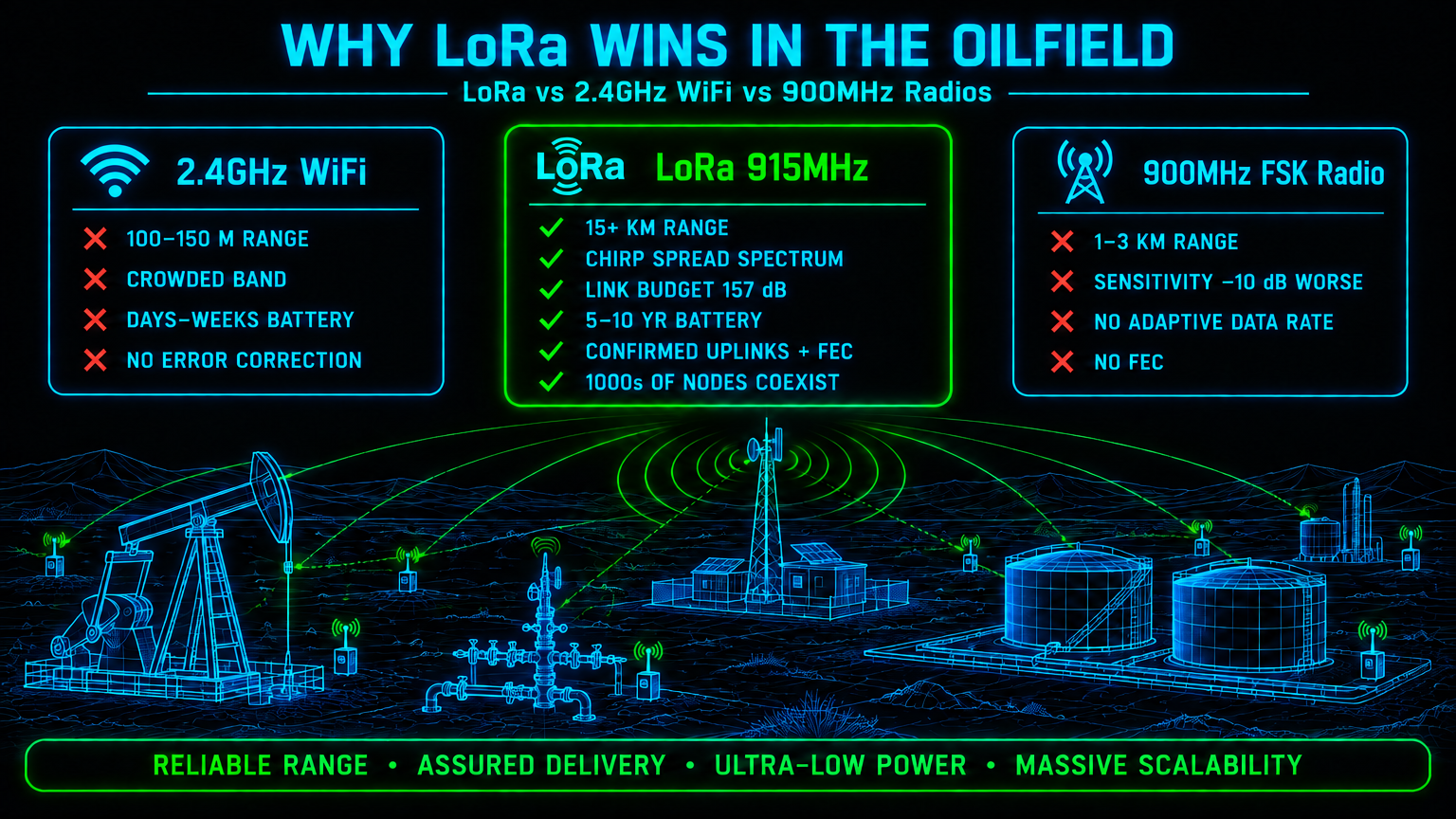
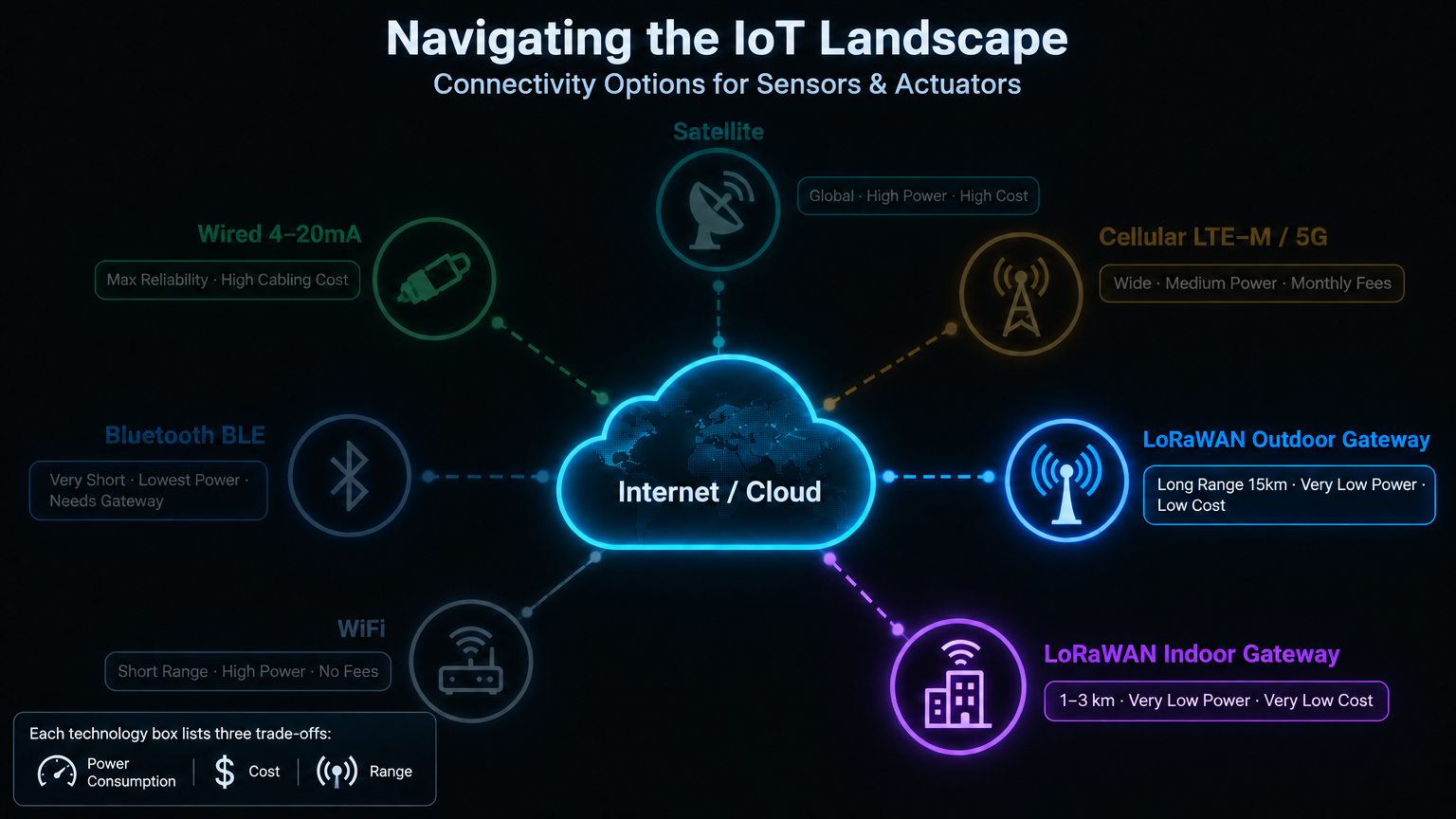
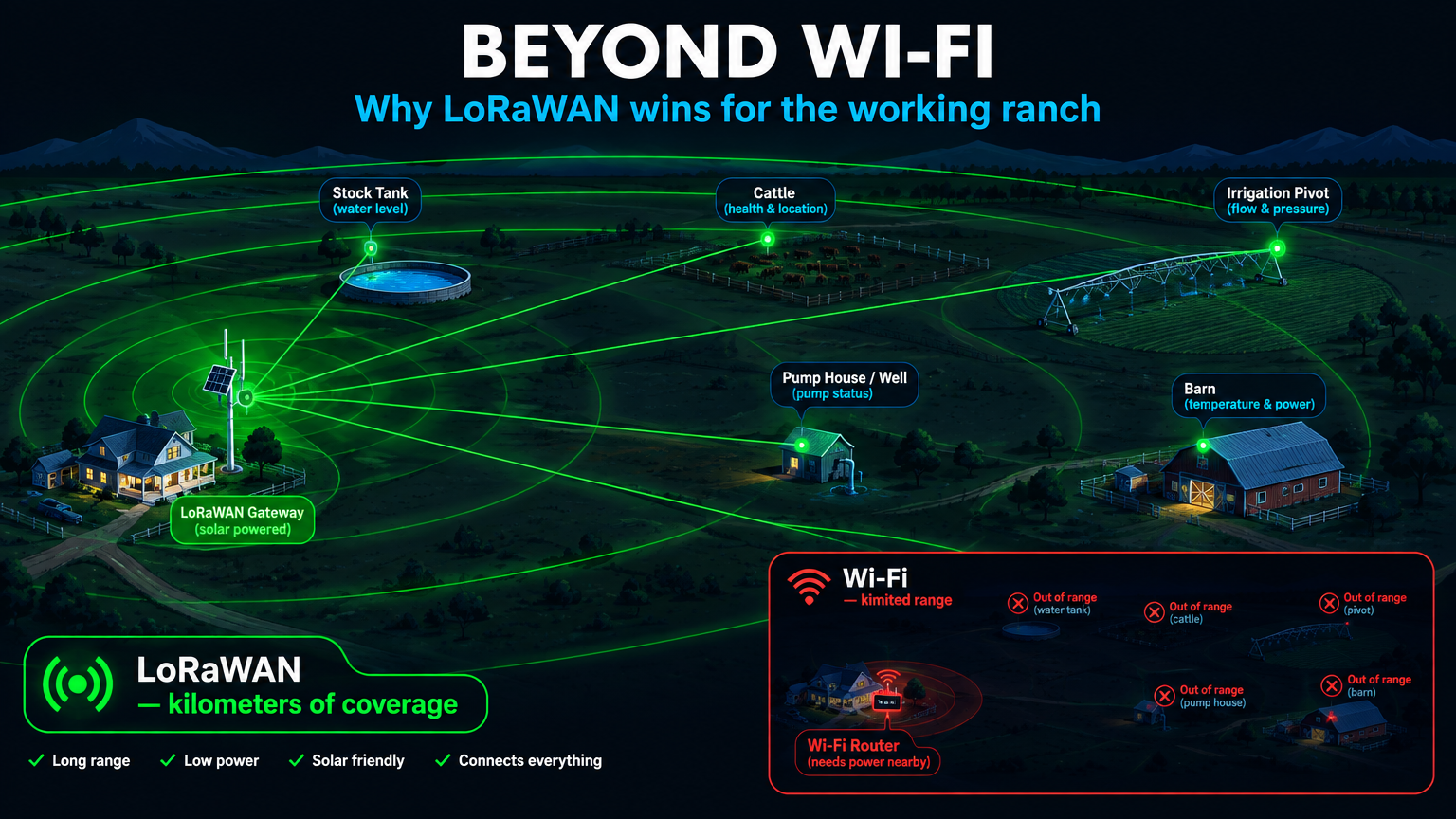
These two technologies cannot be compared. WiFi is great for a 100 ft, and LoRa is great for up to 8 miles (optimal). LoRa is low power and WiFi uses lots of power. WiFi is great for laptops to get the internet. LoRa is great for wire replacement.


Reviews
There are no reviews yet.